Stakeholder Management Plan for PMP: The Complete Guide
Stakeholder Management Plan for PMP: The Complete Guide
Stakeholder management sits inside the People domain, which makes up a significant share of PMP exam questions. It is also one of the areas where situational judgment questions are hardest to answer through memorization alone, because the correct response usually depends on reading a specific scenario carefully rather than recalling a definition.
Most candidates underestimate this topic because it feels intuitive. Then they hit a scenario question describing a stakeholder with high power and low interest, and realize the intuitive answer and the PMI-preferred answer are not always the same thing. This guide breaks down exactly what the exam expects, using the frameworks PMI itself teaches.
The four PMBOK stakeholder management processes
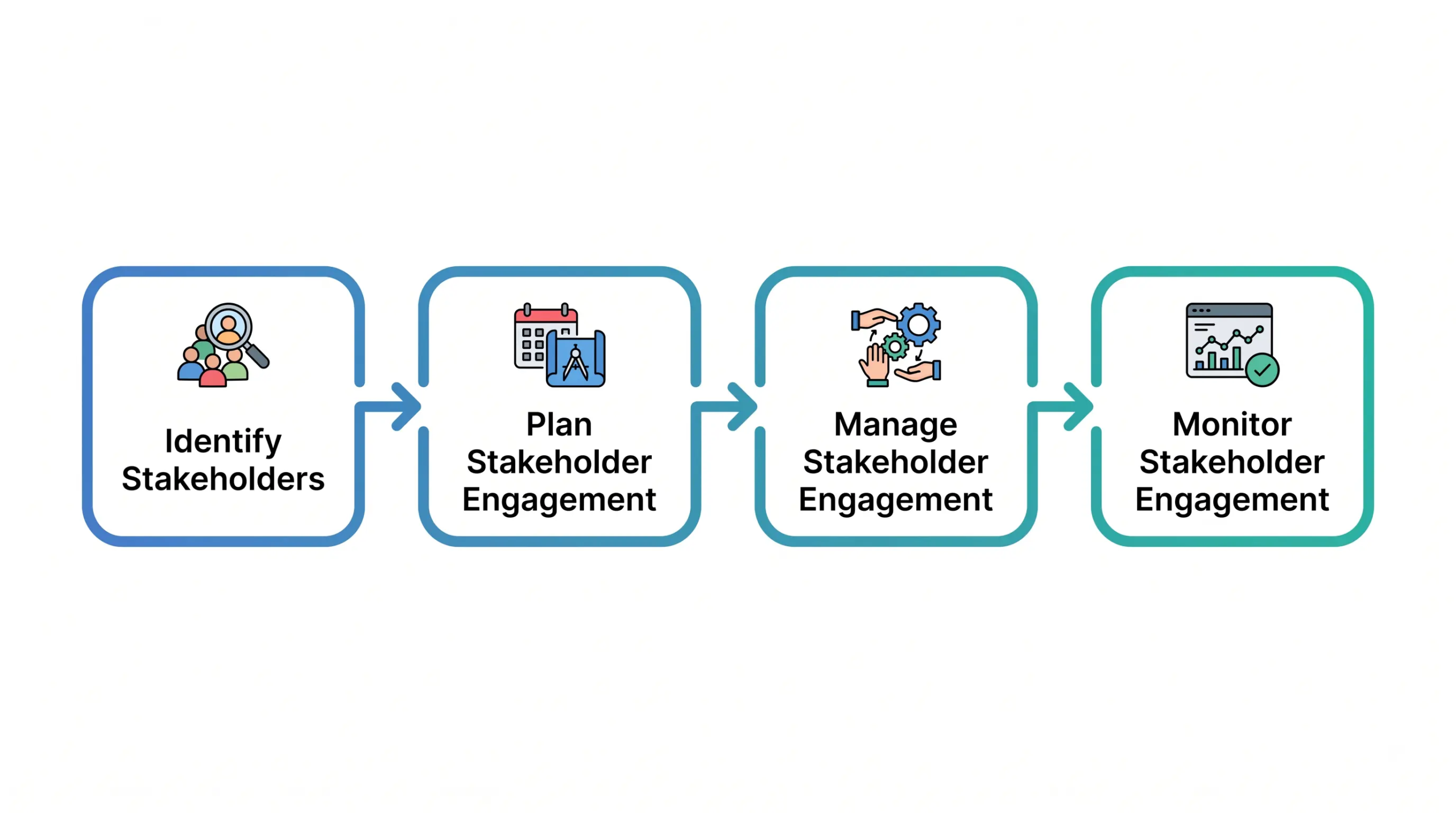
Stakeholder management in the PMBOK Guide is organized into four processes. Understanding what happens in each one, and in which order, is foundational to answering scenario questions correctly.
- Identify Stakeholders. This happens primarily during project initiation, but it is not a one-time activity. New stakeholders can emerge at any point in the project, and this process repeats iteratively throughout the project lifecycle. The core output is the Stakeholder Register, which lists every individual, group, or organization that could affect or be affected by the project.
- Plan Stakeholder Engagement. This is a planning process where the project team develops strategies to involve stakeholders appropriately, based on their needs, expectations, and potential impact on the project. This is the process that produces the stakeholder management plan itself.
- Manage Stakeholder Engagement. This happens during project execution. The project manager actively communicates and works with stakeholders to meet their needs, address issues, and encourage appropriate engagement in project activities and decisions.
- Monitor Stakeholder Engagement. This happens throughout project execution and control. The project team tracks overall stakeholder relationships and adjusts strategies and plans as needed, based on how engagement is actually evolving compared to what was planned.
A useful way to remember the sequence: identify who they are, plan how you will engage them, actually engage them, then check whether that engagement is working and adjust.
The five stakeholder engagement levels
When assessing where a stakeholder currently stands and where you need them to be, PMI defines five distinct engagement levels. These appear frequently in exam scenarios, so knowing the exact order and meaning of each one matters.
Unaware. The stakeholder has no knowledge of the project or its potential impacts on them.
Resistant. The stakeholder is aware of the project and its potential impacts, but is opposed to it, whether due to concerns about the project itself or how it might affect them.
Neutral. The stakeholder is aware of the project but is neither supportive nor resistant.
Supportive. The stakeholder is aware of the project and its potential impacts, and is supportive of the work and its outcomes.
Leading. The stakeholder is not only aware and supportive, but is actively engaged in helping ensure the project succeeds.
The exam frequently tests whether you can identify the gap between a stakeholder’s current engagement level and their desired engagement level, and what specific action closes that gap. A regulator who is currently neutral but needs to become supportive for a permit approval, for example, requires a different strategy than a resistant end user who needs to move to neutral before rollout.
The Power/Interest Grid explained
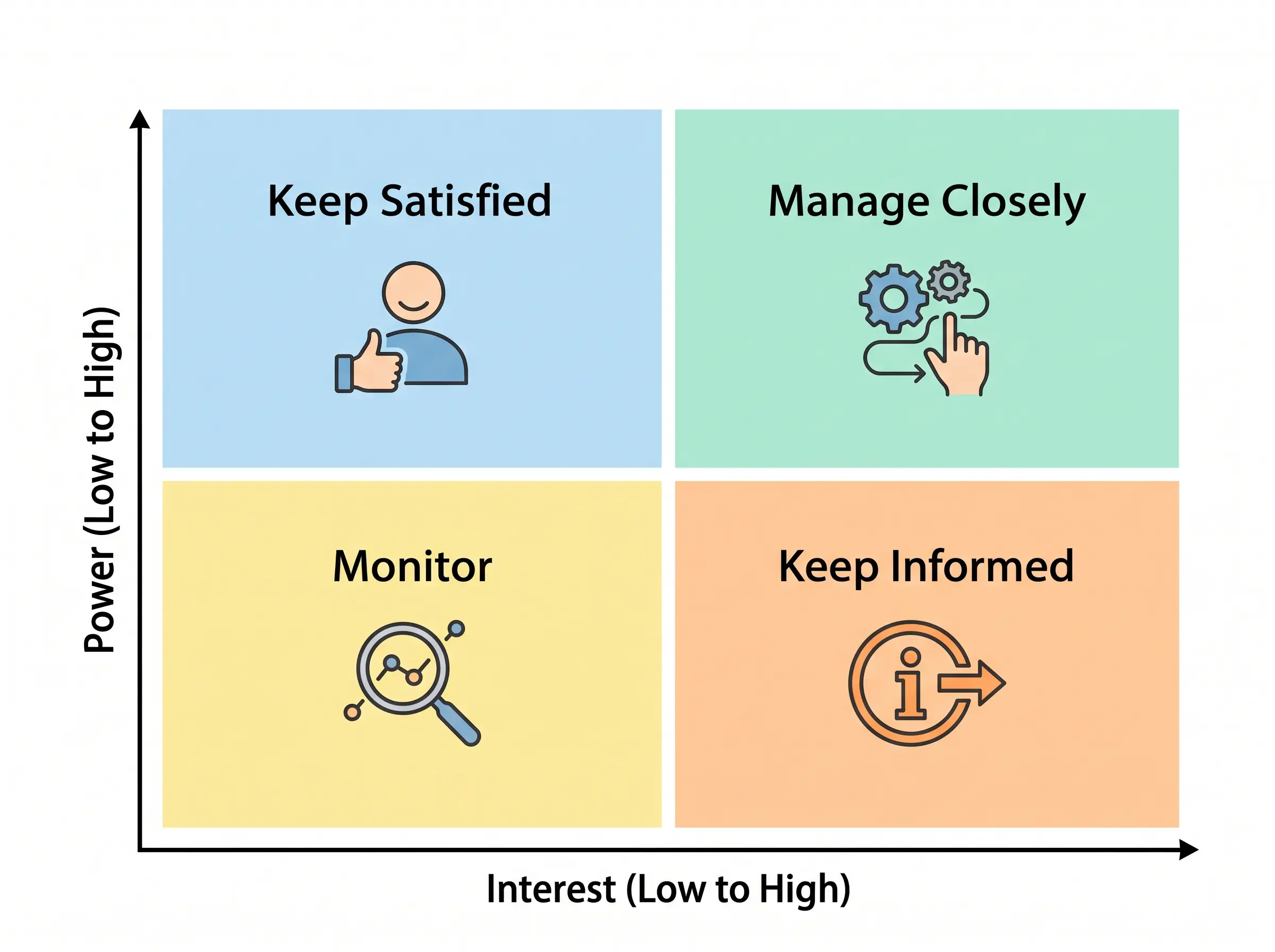
The Power/Interest Grid is the most commonly referenced stakeholder analysis tool, both in real project work and on the PMP exam. It plots every stakeholder along two dimensions: how much power or influence they hold over the project, and how much interest they have in its outcome.
This produces four quadrants, each requiring a different engagement approach.
High power, high interest: Manage closely. These are your most critical stakeholders. They have both the influence to affect the project and a strong stake in its outcome. They need frequent, direct engagement and should never be surprised by project developments.
High power, low interest: Keep satisfied. These stakeholders could significantly affect the project if they became more engaged, but currently have limited interest. The goal is to keep them satisfied with periodic updates, without overwhelming them with detail they have not asked for.
Low power, high interest: Keep informed. These stakeholders care about the project and want to know what is happening, but do not hold significant influence over its direction. Regular, clear communication keeps them engaged without requiring the intensive management reserved for high-power stakeholders.
Low power, low interest: Monitor. These stakeholders require minimal effort. Light monitoring is sufficient, since neither their influence nor their interest currently warrants active engagement.
A frequent exam trap: a stakeholder’s quadrant can shift over the course of a project. A regulator with low interest during initiation can become high interest and high power the moment a compliance issue surfaces. The Power/Interest Grid is not a one-time exercise; it needs to be revisited as the project evolves.
The Stakeholder Engagement Assessment Matrix
Where the Power/Interest Grid helps you decide how to engage stakeholders, the Stakeholder Engagement Assessment Matrix helps you track whether that engagement is actually working.
This matrix compares each stakeholder’s current engagement level against their desired engagement level, using the five levels covered earlier: Unaware, Resistant, Neutral, Supportive, and Leading.
The practical use is straightforward. List every key stakeholder. Mark a C on the matrix for their current engagement level. Mark a D for their desired engagement level. Where C and D are far apart, that is where your engagement strategy needs the most attention. Where C and D already align, that stakeholder needs less active management.
This tool matters on the exam because questions frequently describe a stakeholder’s current behavior in detail and ask what document or tool the project manager should consult or update. If the scenario is about comparing current versus desired engagement, the Stakeholder Engagement Assessment Matrix is almost always the correct reference, not the Power/Interest Grid, which is used for prioritization and strategy rather than gap tracking.
Building a stakeholder management plan step by step
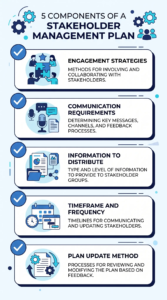
The stakeholder management plan itself is the output of the Plan Stakeholder Engagement process. It typically includes the following components.
Stakeholder engagement strategies, tailored to each stakeholder or stakeholder group based on their power, interest, and current versus desired engagement level.
Communication requirements, including preferred methods, frequency, and language or format needs for each stakeholder or group.
Information to be distributed, specifying what each stakeholder needs to know and at what level of detail.
Timeframe and frequency for distributing required information to each stakeholder.
Method for updating the plan as the project progresses and stakeholder engagement evolves.
In practice, building this plan starts with a workshop or structured session to identify all stakeholders, followed by plotting them on the Power/Interest Grid, then defining specific engagement tactics for each quadrant, and finally establishing a review cadence to reassess the plan as the project moves through its lifecycle.
Common PMP exam traps on stakeholder questions
Confusing the Power/Interest Grid with the Stakeholder Engagement Assessment Matrix. These are two different tools serving two different purposes. The grid is for prioritizing and strategizing. The matrix is for tracking the gap between current and desired engagement.
Assuming high power always means high priority attention. A high power, low interest stakeholder needs to be kept satisfied, not managed as intensively as a high power, high interest stakeholder. Overengaging a low-interest stakeholder can actually create friction.
Treating stakeholder identification as a one-time activity. The exam frequently tests whether you understand that stakeholder identification continues throughout the project, not just during initiation. New stakeholders, especially external ones like regulators or new leadership, can emerge at any stage.
Forgetting that a resistant stakeholder is not the same as a hostile one. Resistant simply means opposed to the project or aspects of it. The correct response is usually further engagement and addressing underlying concerns, not escalation or exclusion.
Overlooking the difference between managing and monitoring stakeholder engagement. Managing engagement happens actively during execution. Monitoring engagement is the ongoing check on whether the strategy is working, which can lead back to updating the plan itself.
Related reading on ShriLearning.
- Top 70+ Project Manager Interview Questions and Answers
- The Use of EAC (Estimate at Completion) in Project Tracking
- Project Procurement Contract Types: The Ultimate PMP Guide
- Risk Management in Project Management
Your first project is calling—will you answer? Join the ShriLearning Community Connect with fellow PMP aspirants and expert instructors. Crete your study plan for free from ShriLearning study-plan-generator.
FAQs
More for you

How to Use AI in Project Management: 10 Practical Workflows
saketpratapsinghdm2026-10-24T15:48:41+05:30October 24th, 2026|
Benefits of Agile Project Management for Small and Medium-Sized Businesses
saketpratapsinghdm2026-09-28T10:12:30+05:30September 28th, 2026|

Work Breakdown Structure (WBS): The Complete PMP Guide, With a Worked Example
saketpratapsinghdm2026-09-21T16:48:15+05:30September 21st, 2026|
Stakeholder Management and RACI: The Complete PMP Guide (With a Worked Example)
saketpratapsinghdm2026-09-21T15:07:42+05:30September 21st, 2026|
How to Write a Problem Statement (With a PMP-Ready Template and Examples)
saketpratapsinghdm2026-09-21T14:42:27+05:30September 21st, 2026|

Earned Value Management: How to Actually Read CPI and SPI (Not Just Calculate Them)
saketpratapsinghdm2026-09-17T15:32:44+05:30September 17th, 2026|

Agile Practice Guide – Second Edition: What Changed, and What It Means for Your PMI-ACP Prep
saketpratapsinghdm2026-09-17T14:45:53+05:30September 17th, 2026|

Why the PMP People Domain Dropped to 33% (And How to Master It in 2026)
saketpratapsinghdm2026-08-27T21:18:31+05:30August 27th, 2026|