Work Breakdown Structure (WBS): The Complete PMP Guide, With a Worked Example
Work Breakdown Structure (WBS): The Complete PMP Guide, With a Worked Example
Here’s a pattern that shows up on almost every troubled project: the expensive surprise wasn’t a risk nobody saw coming. It was a piece of work nobody claimed — an integration step, a compliance review, a handoff between two teams that both assumed the other owned it. By the time it surfaces, it costs far more to fix than it would have cost to plan for.
The work breakdown structure (WBS) exists specifically to catch that work before it becomes a surprise. It’s also one of the most heavily tested concepts on the PMP exam, and one of the most commonly misunderstood in practice — even experienced PMs regularly confuse a WBS with a schedule, an org chart, or a simple to-do list. This guide covers what a WBS actually is, how to build one correctly, where PMP candidates lose marks on it, and a full worked example you can adapt.
What Is a Work Breakdown Structure?
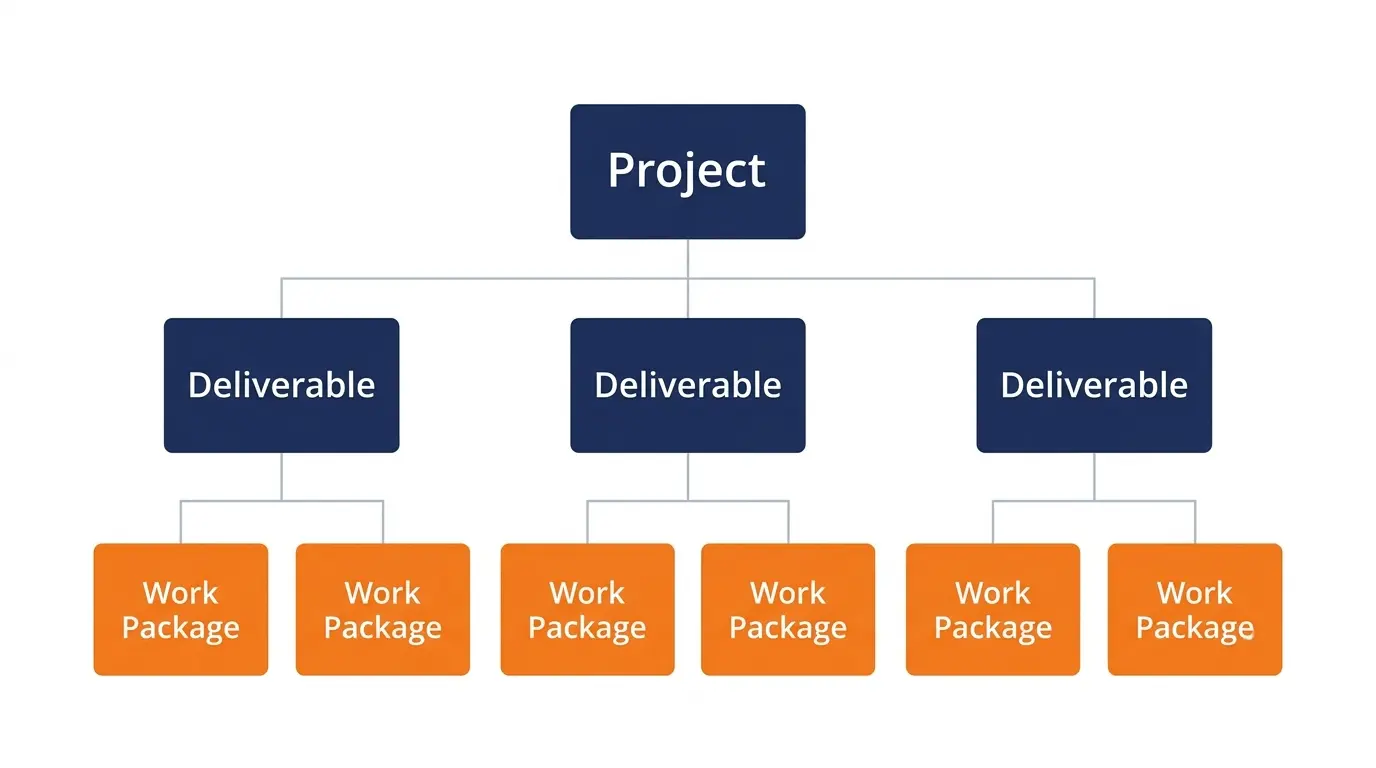
A work breakdown structure is a deliverable-oriented, hierarchical breakdown of a project’s total scope into smaller, manageable components. Picture a family tree of the work: the whole project sits at the top, and each level below it is a more detailed slice of the level above, until you reach pieces small enough to assign, estimate, and track individually.
A handful of terms carry the whole concept, and PMP questions test the distinctions between them precisely:
| Term | What it is | Why it matters |
|---|---|---|
| Deliverable | A tangible, verifiable outcome the project produces | The WBS is organized around these — not around activities or tasks |
| Decomposition | The act of subdividing deliverables into smaller components | How you actually build the tree, level by level |
| Work package | The lowest-level element of the WBS, owned by one person or team | Where estimating, assigning, and tracking actually happen |
| Control account | A management point where scope, budget, and schedule for a group of work packages come together | Where performance is measured and rolled up for reporting |
| WBS dictionary | The companion document defining each element — scope, owner, resources, acceptance criteria | Removes ambiguity about exactly what a work package includes |
| Scope baseline | The approved scope statement, WBS, and WBS dictionary together | What every future scope change is measured against |
The design principle that ties all of this together is the 100% rule: the WBS must include 100% of the work defined by the project scope — no more, no less — and the child elements of any branch must sum to exactly that branch, no gaps and no extra work sneaking in. The exam-ready version of the old saying still holds: if it isn’t in the WBS, it isn’t in the project, and any work not represented there needs formal authorization before anyone starts it.
WBS vs. Schedule vs. RBS vs. OBS — The Distinction PMP Questions Test Most
This is the single most common point of confusion, and it’s a favorite trap in scenario-based PMP questions.
- WBS (Work Breakdown Structure) shows what work needs to happen, organized by deliverable. No dates, no sequence, no assigned people.
- Project schedule takes the work packages from the WBS and adds sequence, duration, and dependencies — it answers when.
- OBS (Organizational Breakdown Structure) shows who — the organization’s reporting structure, used to map responsibility onto WBS elements.
- RBS (Resource Breakdown Structure) shows resources — people, equipment, materials — organized by category and type, used for resource planning and estimating.
If you’re prepping for the exam and want to build the estimating skills that plug directly into work packages, our guide to project estimating techniques is the natural next read — a WBS tells you what to estimate; that guide tells you how.
Build It From Deliverables, Not Activities
The most common WBS mistake — in practice and on the exam — is building it around activities (“hold kickoff meeting,” “send status email”) instead of deliverables. That produces a task list, not a WBS, and it breaks the 100% rule because activities don’t cleanly sum to a scope boundary the way deliverables do.
Work top-down:
- Name the major deliverables at the first level — the big outcomes the project produces.
- Decompose each deliverable into its components, one level at a time.
- Stop at work packages small enough for one owner to estimate, assign, and track — but before the detail costs more to manage than it informs.
- Keep elements mutually exclusive. No two branches should cover the same piece of work; overlap is one of the fastest ways to create double-counted costs or confused ownership.
- Write the WBS dictionary entry for each work package so the label isn’t left open to interpretation.
That dictionary entry is what turns a box on a diagram into something a person can actually act on:
| Field | Example entry |
|---|---|
| Work package | 1.3.2 User Acceptance Testing |
| Owner | QA Lead |
| Deliverable | Signed-off UAT report confirming all critical test cases pass |
| Acceptance criteria | Zero open critical/high defects; sign-off from business stakeholder |
| Dependencies | Feature-complete build (1.2.4); test environment provisioned |
A Worked Example: Mobile App Launch
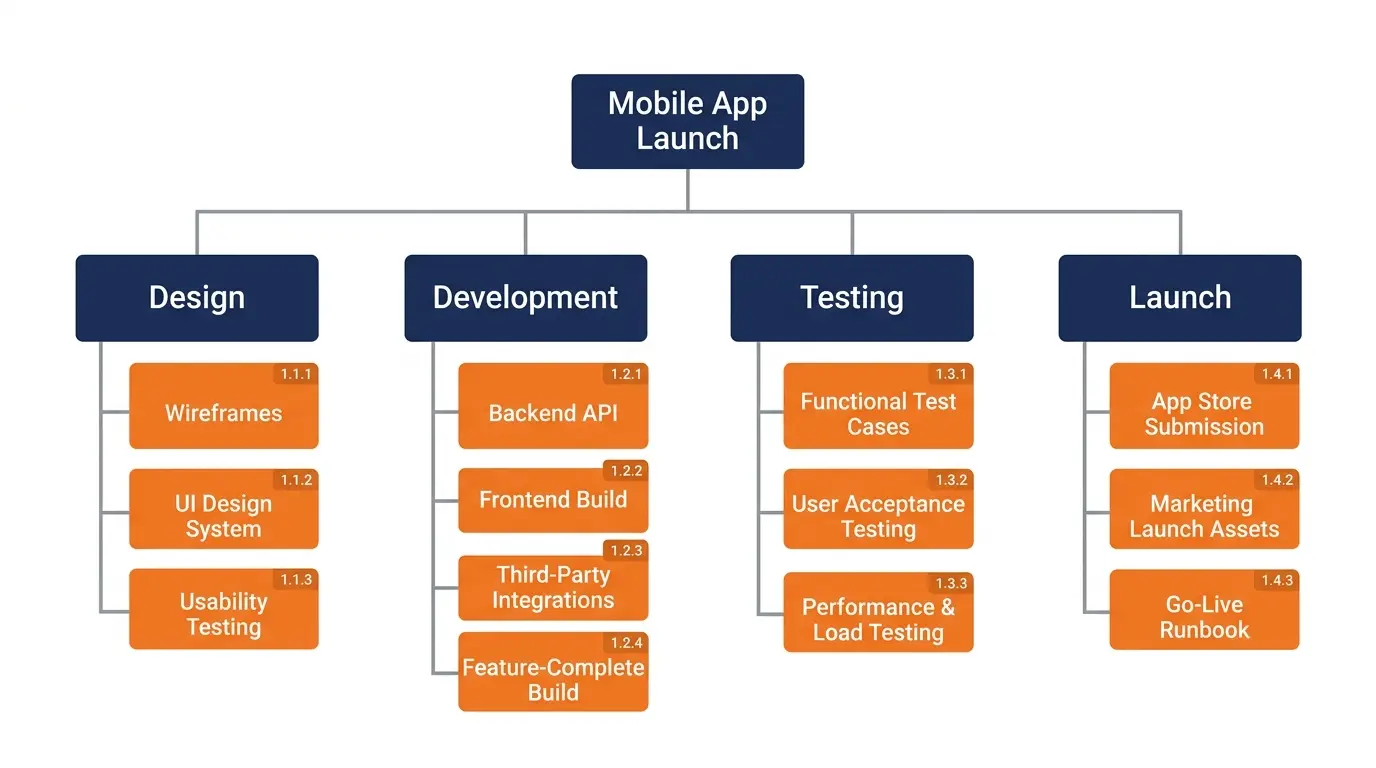
Here’s a simplified WBS for a mobile app launch, decomposed to work-package level for one branch so you can see the pattern:
1.0 Mobile App Launch
1.1 Design
1.1.1 Wireframes
1.1.2 UI Design System
1.1.3 Usability Testing Report
1.2 Development
1.2.1 Backend API
1.2.2 Frontend Build
1.2.3 Third-Party Integrations
1.2.4 Feature-Complete Build
1.3 Testing
1.3.1 Functional Test Cases
1.3.2 User Acceptance Testing
1.3.3 Performance & Load Testing
1.4 Launch
1.4.1 App Store Submission Package
1.4.2 Marketing Launch Assets
1.4.3 Go-Live Runbook
1.5 Project Management
1.5.1 Status Reports
1.5.2 Risk Register
1.5.3 Lessons Learned Report
Notice two things a PMP question would test here. First, every leaf node is a noun (a deliverable), not a verb (an activity) — “User Acceptance Testing” is the deliverable of the testing process, not the act of testing. Second, “Project Management” appears as its own branch at level 1.5 — a detail people frequently forget, and one the 100% rule requires, since project management work (status reporting, risk management) is real, budgeted work inside the project scope.
Why the WBS Is the Foundation for Everything Else in Planning
Once the WBS and its dictionary are baselined, almost every other planning document depends on it directly:
- Estimating and budgeting happen at the work-package level, then roll up through control accounts to the project budget — which is exactly why a weak WBS tends to produce a shaky budget. If your budgeting process is where things go wrong, our guide on how to manage a project budget picks up from here.
- Earned value management is only as reliable as the baseline underneath it. A dashboard can calculate CPI and SPI perfectly and still mislead you completely if the WBS it’s measuring against is soft or incomplete — see our guide on reading earned value data for how that plays out in practice.
- The schedule is built by sequencing and estimating duration for the same work packages the WBS defines — the WBS answers “what,” the schedule answers “when.”
- Risk identification frequently works branch by branch through the WBS, since risks tend to attach to specific deliverables rather than the project as an abstract whole.
Does a WBS Work for Agile and Hybrid Projects?
Yes, with a shift in vocabulary rather than a change in principle. On adaptive projects, a WBS can align with or support a product backlog, with scope elaborated through epics and user stories instead of fixed work packages defined upfront. It’s common to define the higher levels of scope early and let the lower branches emerge as the work becomes clearer — consistent with how our Agile vs. Predictive guide frames the hybrid spectrum generally. The 100% rule still applies conceptually: the backlog, taken as a whole, should represent the full scope of what’s been committed.
Common PMP Exam Traps on WBS Questions
A few patterns show up repeatedly in scenario-based questions:
- Confusing the WBS with the schedule. If a question mentions dates, sequencing, or “which comes first,” it’s testing the schedule, not the WBS — don’t reach for WBS terminology in your answer.
- Treating the WBS as an org chart. A WBS never shows who reports to whom. That’s the OBS. If a question describes reporting lines, it’s not describing a WBS.
- Missing the “100% rule” phrasing. Exam questions often test this rule indirectly, by describing a WBS with a gap or an overlap and asking what principle was violated.
- Forgetting that project management is itself a deliverable. Status reports, the risk register, and lessons-learned documentation belong somewhere in the WBS — they’re real project work, not overhead sitting outside it.
- Decomposing too far or not far enough. The rule of thumb tested on the exam: decompose until a work package can be reliably estimated and assigned to one owner, and stop there. Going further just adds management overhead without adding planning value.
Key Takeaways
- A WBS is a deliverable-oriented hierarchy of a project’s total scope — never an activity list, a schedule, or an org chart.
- The 100% rule is the core design principle: all the work in scope, organized so each branch sums exactly to the level above it, with nothing missing and nothing extra.
- Work packages are the lowest level — small enough for one owner to estimate and track — and a WBS dictionary defines exactly what each one includes.
- Almost everything downstream (budgeting, scheduling, earned value tracking, risk identification) depends on the WBS being built correctly first.
- On the PMP exam, the most common trap is confusing the WBS with the schedule (when) or the OBS (who) — the WBS only ever answers what.
Preparing for the PMP exam? Scope and WBS fundamentals are core to the Process domain of the current exam. ShriLearning’s PMP online training covers WBS construction with worked, exam-style examples like the one above.
FAQs
More for you

Work Breakdown Structure (WBS): The Complete PMP Guide, With a Worked Example
saketpratapsinghdm2026-09-21T16:48:15+05:30September 21st, 2026|
Stakeholder Management and RACI: The Complete PMP Guide (With a Worked Example)
saketpratapsinghdm2026-09-21T15:07:42+05:30September 21st, 2026|
How to Write a Problem Statement (With a PMP-Ready Template and Examples)
saketpratapsinghdm2026-09-21T14:42:27+05:30September 21st, 2026|

Earned Value Management: How to Actually Read CPI and SPI (Not Just Calculate Them)
saketpratapsinghdm2026-09-17T15:32:44+05:30September 17th, 2026|

Agile Practice Guide – Second Edition: What Changed, and What It Means for Your PMI-ACP Prep
saketpratapsinghdm2026-09-17T14:45:53+05:30September 17th, 2026|

Why the PMP People Domain Dropped to 33% (And How to Master It in 2026)
saketpratapsinghdm2026-08-27T21:18:31+05:30August 27th, 2026|

CSM Certification Guide India (2026): Cost, Eligibility, Salary & Exam Steps
saketpratapsinghdm2026-09-17T15:37:52+05:30August 21st, 2026|

Stakeholder Management Plan for PMP: The Complete Guide
saketpratapsinghdm2026-08-21T14:04:07+05:30August 13th, 2026|