Earned Value Management: How to Actually Read CPI and SPI (Not Just Calculate Them)
Earned Value Management: How to Actually Read CPI and SPI (Not Just Calculate Them)
Ask any PMP-certified project manager to calculate CPI and SPI, and they’ll have the numbers in under a minute — most project tools do it automatically now. Ask the same person what a CPI of 0.80 paired with an SPI of 0.90 actually means for next week’s decisions, and the answer gets a lot less confident.
That gap — between computing earned value and reading it — is exactly where earned value management (EVM) earns its reputation as a spreadsheet chore instead of the diagnostic tool it’s meant to be. If you already know the formulas (or want them fast, see our PMP EVM formulas cheat sheet for a full reference table), this piece picks up where the formulas stop: how to interpret what the numbers are telling you, and what to actually do about it.
What Earned Value Management Actually Measures
EVM compares three numbers, all expressed in the same unit (usually money), to answer one question honestly: is this project on track, or does it just look that way?
- Planned value (PV) — what you budgeted to have finished by now. Your baseline for “on track.”
- Earned value (EV) — the budgeted value of work you’ve actually finished, not hours logged or money spent.
- Actual cost (AC) — what you’ve genuinely spent to get there.
If your training covered the older PMBOK terms (BCWS, BCWP, ACWP), these are the same three ideas with plainer names. None of it means anything without a solid baseline underneath it — a clear scope statement and a deliverable-based work breakdown structure. A dashboard can calculate earned value perfectly and still mislead you completely if the baseline it’s measuring against is soft. If your WBS or estimates feel shaky, it’s worth revisiting our guide on project estimating techniques before you trust any EVM output built on top of them.
The Formulas, Quickly — Then We Move to Interpretation
| Term | Formula | What it tells you |
|---|---|---|
| Schedule variance (SV) | EV − PV | Ahead (+) or behind (−) plan, in money terms |
| Cost variance (CV) | EV − AC | Under (+) or over (−) budget |
| Schedule Performance Index (SPI) | EV ÷ PV | Pace vs. plan (1.0 = exactly on pace) |
| Cost Performance Index (CPI) | EV ÷ AC | Value earned per rupee spent |
| Estimate at Completion (EAC) | BAC ÷ CPI | Projected final cost if current efficiency holds |
| To-Complete Performance Index (TCPI) | (BAC − EV) ÷ (BAC − AC) | Efficiency needed from here to still hit budget |
For the complete formula set — including less common ones like VAC and ETC, with worked PMP-exam-style examples — the EVM formulas cheat sheet covers every variant you’re likely to see on exam day. This piece is deliberately about the next step: what these numbers mean once you have them.
Reading CPI and SPI Together, Not Separately
The mistake most new PMs make is reading CPI and SPI as two separate report cards. They’re not — they’re two dimensions of the same story, and the combination matters more than either number alone.
Take a $100,000 project, four months in. You planned to have finished $40,000 of work (PV). You’ve actually finished $36,000 worth (EV), and spent $45,000 to do it (AC).
| Measure | Result | What it says |
|---|---|---|
| SV (EV − PV) | −$4,000 | Slightly behind plan |
| CV (EV − AC) | −$9,000 | Spent more than the work is worth |
| SPI (EV ÷ PV) | 0.90 | Completing work at 90% of planned pace |
| CPI (EV ÷ AC) | 0.80 | Getting 80 cents of value per rupee spent |
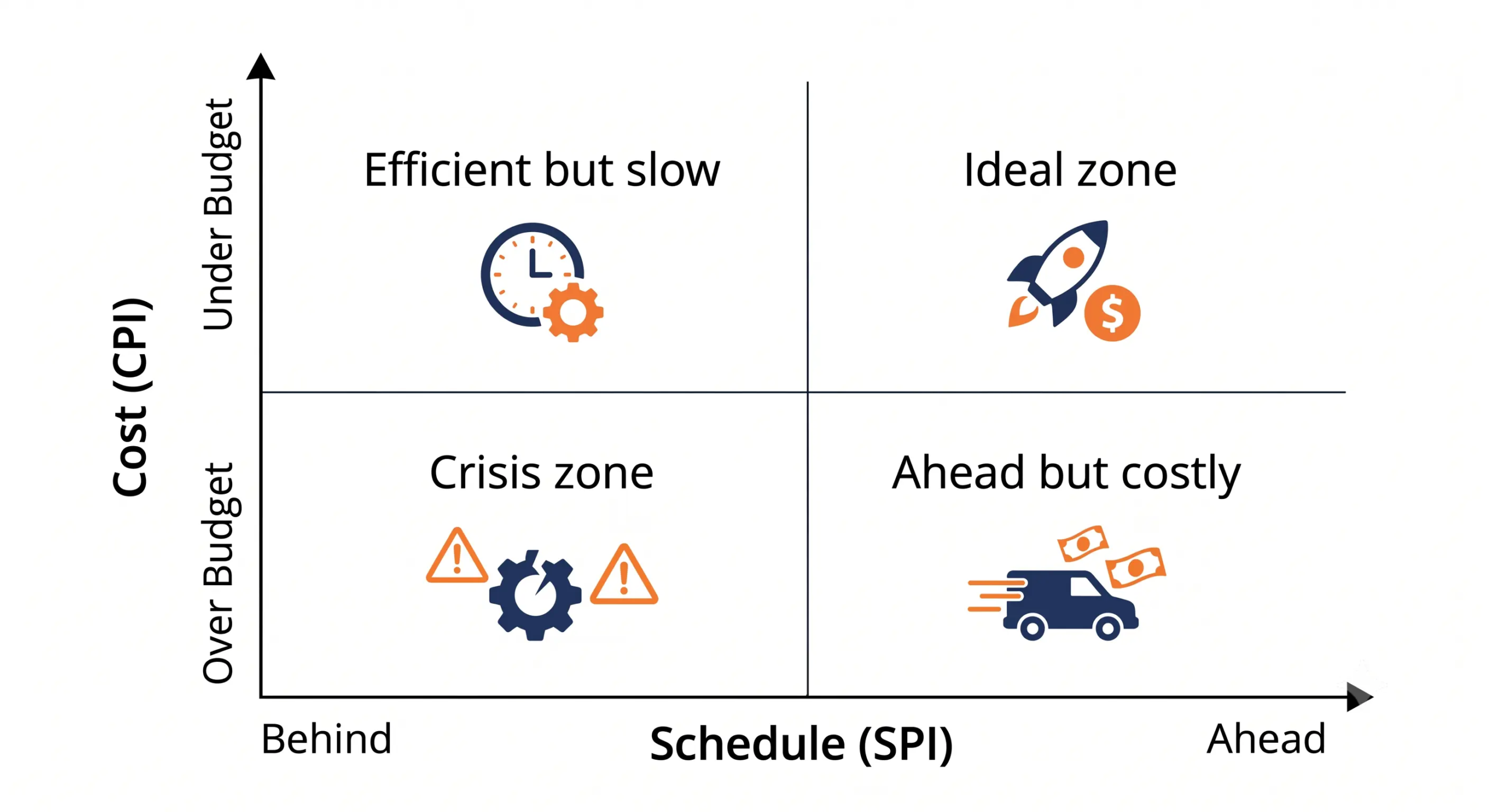
Here’s the interpretation a formula alone won’t give you: an SPI of 0.90 next to a CPI of 0.80 is a specific kind of warning. You’re only slightly behind schedule, but meaningfully over budget — which usually points to burning resources faster than you’re producing results, not simply running late. That’s a resourcing or efficiency problem, not a scheduling one, and the fix is different. A pure “SPI is low, add more people” response would make the CPI problem worse.
As a quick mental model: plot CPI and SPI against each other. Both above 1.0 is the ideal zone. Both below 1.0 is a genuine crisis — over budget and behind schedule. One up, one down tells you which lever to pull. This is the exact judgment call that separates someone who can calculate EVM from someone who can manage with it — the kind of scenario-based thinking the PMP exam tests directly, alongside topics like contingency vs. management reserves when a variance eats into your buffer.
Forecasting Forward With EAC — Before the Overrun Is Obvious
The real value of EVM isn’t grading what already happened — it’s catching a problem early enough to still change the outcome. That’s what Estimate at Completion (EAC) is for: a forecast of total project cost if current performance continues.
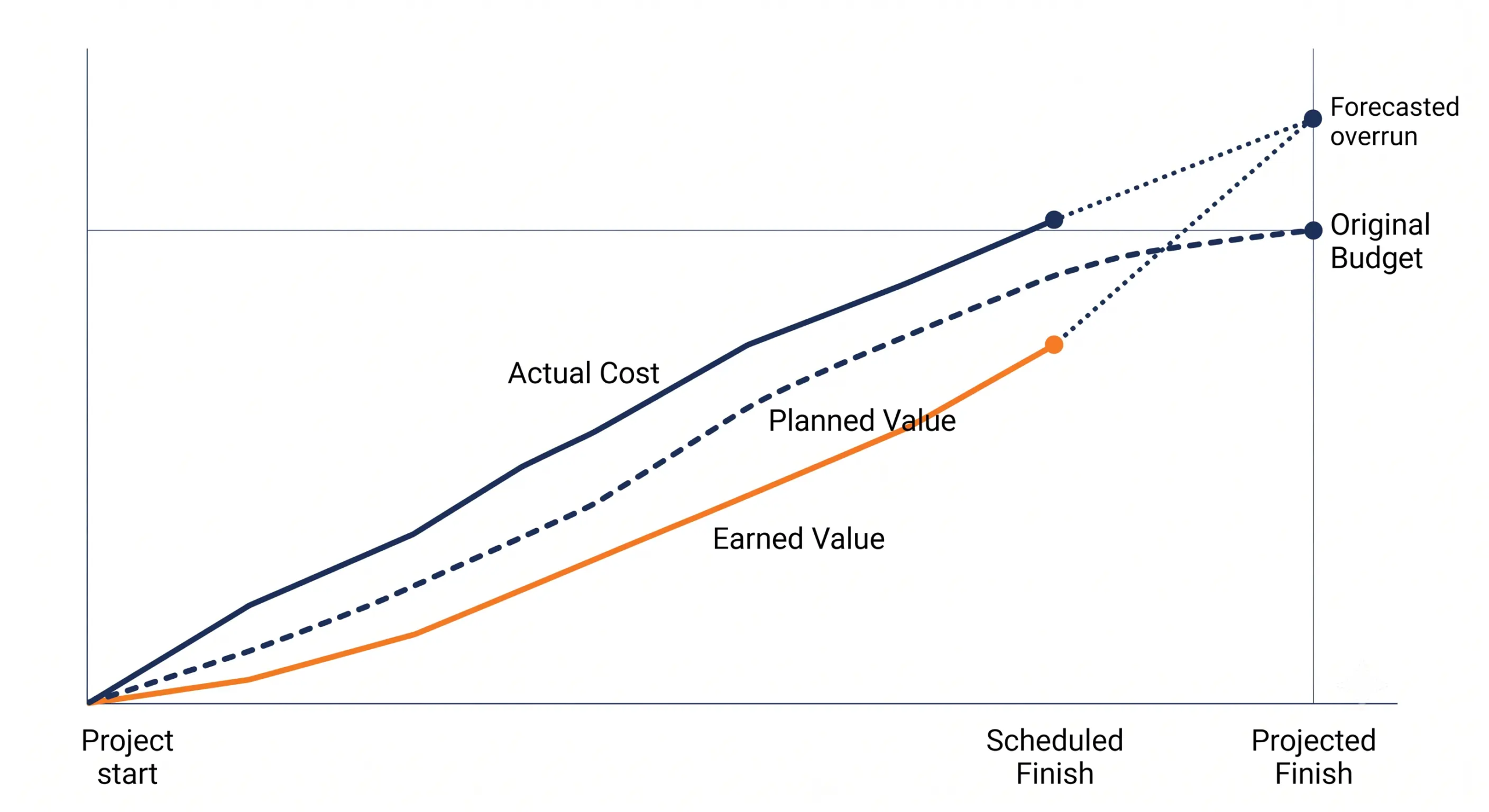
Using the numbers above:
EAC = BAC ÷ CPI = $100,000 ÷ 0.80 = $125,000
That’s a $25,000 overrun, visible in month four instead of surfacing as a surprise in month ten. For the full mechanics of EAC — including the alternate formulas PMI uses when atypical variances are expected — see our dedicated EAC guide.
A companion figure, TCPI, flips the question: what cost efficiency would you need from here on to still land on budget? If TCPI climbs well above your current CPI, you’re looking at a target the team probably can’t hit without an actual change in plan — not just tighter execution.
What the Tools Do — and What They Still Can’t
Modern project platforms and AI-powered dashboards calculate CPI, SPI, and EAC continuously, and some now flag variances before you’ve noticed them yourself. That’s a genuine improvement — nobody should be doing this arithmetic by hand every week.
But automation removes the excuse for not having the numbers; it doesn’t remove the responsibility for understanding them. When a dashboard flags a slipping CPI, a person still has to judge what’s actually driving it, whether the signal is trustworthy, and whose decision it is to act. A tool can tell you the CPI dropped. It can’t tell you that the drop started the week a key vendor missed a delivery, or that a “90% complete” status has been sitting unchanged for three weeks because nobody wants to report the real number.
That last one is the most common way EVM data goes wrong: subjective, ungrounded percent-complete reporting. If a task claims “90% done” for three straight status updates, you’re not reading earned value — you’re reading fiction with a formula applied to it. Earn value only against objective, agreed completion criteria.
A Simple Rhythm for Every EVM Review
- Check the data before the story. Delayed actuals and gamed percent-complete manufacture variances that aren’t real, or hide ones that are.
- Read the trend, not the single data point. One period below 1.0 might be noise. Three in a row is a pattern worth escalating.
- Name the driver in plain language. “SPI is 0.90” is a number. “Design sign-offs are running two weeks late and it’s on the critical path” is something a stakeholder can act on.
- Close with a decision and an owner. Monitor, correct, escalate, or replan — and say who’s doing it, by when.
A clean variance with a named driver and a forecast impact (“$25,000 over, next milestone at risk”) turns a vague worry into a specific, hard-to-ignore ask — even when the fix isn’t yours to make directly.
Does EVM Work on Agile and Hybrid Projects?
Yes, with a small adjustment. On agile or hybrid teams, EVM works using story points, iterations, or releases instead of traditional work packages — whatever unit the team already plans and measures against. The earning rule stays strict either way: count value only when a story or increment is genuinely done and accepted, never while it’s still in progress, or your SPI becomes meaningless. If you’re studying for the PMI-ACP or working across predictive and agile approaches, it’s worth reading how the Agile Practice Guide’s continuum model reframes hybrid delivery — the same “objective definition of done” discipline applies to earned value regardless of which side of the continuum you’re working on. Our breakdown of Agile vs. Predictive approaches is a useful primer if you’re not sure which measurement approach fits your project.
Key Takeaways
- CPI and SPI are calculated in seconds by any modern tool — the actual skill is interpreting what they mean together, not separately.
- A low CPI with a near-normal SPI usually signals inefficiency (burning resources without proportional output), not just delay — and the fix for each is different.
- EAC exists to catch overruns early enough to still act on them, not to confirm what’s already obvious.
- Automation doesn’t remove your responsibility to judge whether a variance is real, what’s driving it, and what to do next.
- EVM works on agile and hybrid projects too, as long as “done” is defined objectively.
Want the complete formula reference with worked PMP-exam examples? Read the EVM Formulas Cheat Sheet. Preparing for your PMP exam more broadly? ShriLearning’s PMP online training covers cost management — including earned value — in full depth against the current exam content outline.
FAQs
More for you

Work Breakdown Structure (WBS): The Complete PMP Guide, With a Worked Example
saketpratapsinghdm2026-09-21T16:48:15+05:30September 21st, 2026|
Stakeholder Management and RACI: The Complete PMP Guide (With a Worked Example)
saketpratapsinghdm2026-09-21T15:07:42+05:30September 21st, 2026|
How to Write a Problem Statement (With a PMP-Ready Template and Examples)
saketpratapsinghdm2026-09-21T14:42:27+05:30September 21st, 2026|

Earned Value Management: How to Actually Read CPI and SPI (Not Just Calculate Them)
saketpratapsinghdm2026-09-17T15:32:44+05:30September 17th, 2026|

Agile Practice Guide – Second Edition: What Changed, and What It Means for Your PMI-ACP Prep
saketpratapsinghdm2026-09-17T14:45:53+05:30September 17th, 2026|

Why the PMP People Domain Dropped to 33% (And How to Master It in 2026)
saketpratapsinghdm2026-08-27T21:18:31+05:30August 27th, 2026|

CSM Certification Guide India (2026): Cost, Eligibility, Salary & Exam Steps
saketpratapsinghdm2026-09-17T15:37:52+05:30August 21st, 2026|

Stakeholder Management Plan for PMP: The Complete Guide
saketpratapsinghdm2026-08-21T14:04:07+05:30August 13th, 2026|