How to Write a Problem Statement (With a PMP-Ready Template and Examples)
How to Write a Problem Statement (With a PMP-Ready Template and Examples)
Most project charters that get rejected at the sponsor review don’t fail because the plan is weak. They fail because nobody can say, in one clear paragraph, what problem the project is actually solving. A vague problem statement — “improve customer experience,” “reduce inefficiencies” — gives a sponsor nothing to approve and a team nothing to aim at.
A problem statement is the short, specific description that fixes that: what’s happening now, what should be happening instead, and by when you intend to close that gap. It’s a required element of most project charters and business cases, it’s tested directly on the PMP exam as part of project initiation, and — done well — it’s the single fastest way to get a skeptical stakeholder to say yes.
What Is a Problem Statement?
A problem statement is a concise, specific description of an issue that needs solving — typically one to three sentences, rarely more than a short paragraph. It names the current state in measurable terms, contrasts it with a defined future state, and sets a target date for closing the gap. It deliberately does not propose a solution, assign blame, or speculate about root cause — those come later, once the problem itself is agreed on.
In project management specifically, the problem statement sits inside the project charter or business case, and it’s the foundation everything else gets justified against: scope, budget, and success criteria are all measured against the gap the problem statement defines. If the problem statement is fuzzy, everything built on top of it inherits that fuzziness.
The Three-Part Structure
A strong problem statement has three components, and PMP-style scenario questions test whether you can identify a statement that’s missing one of them:
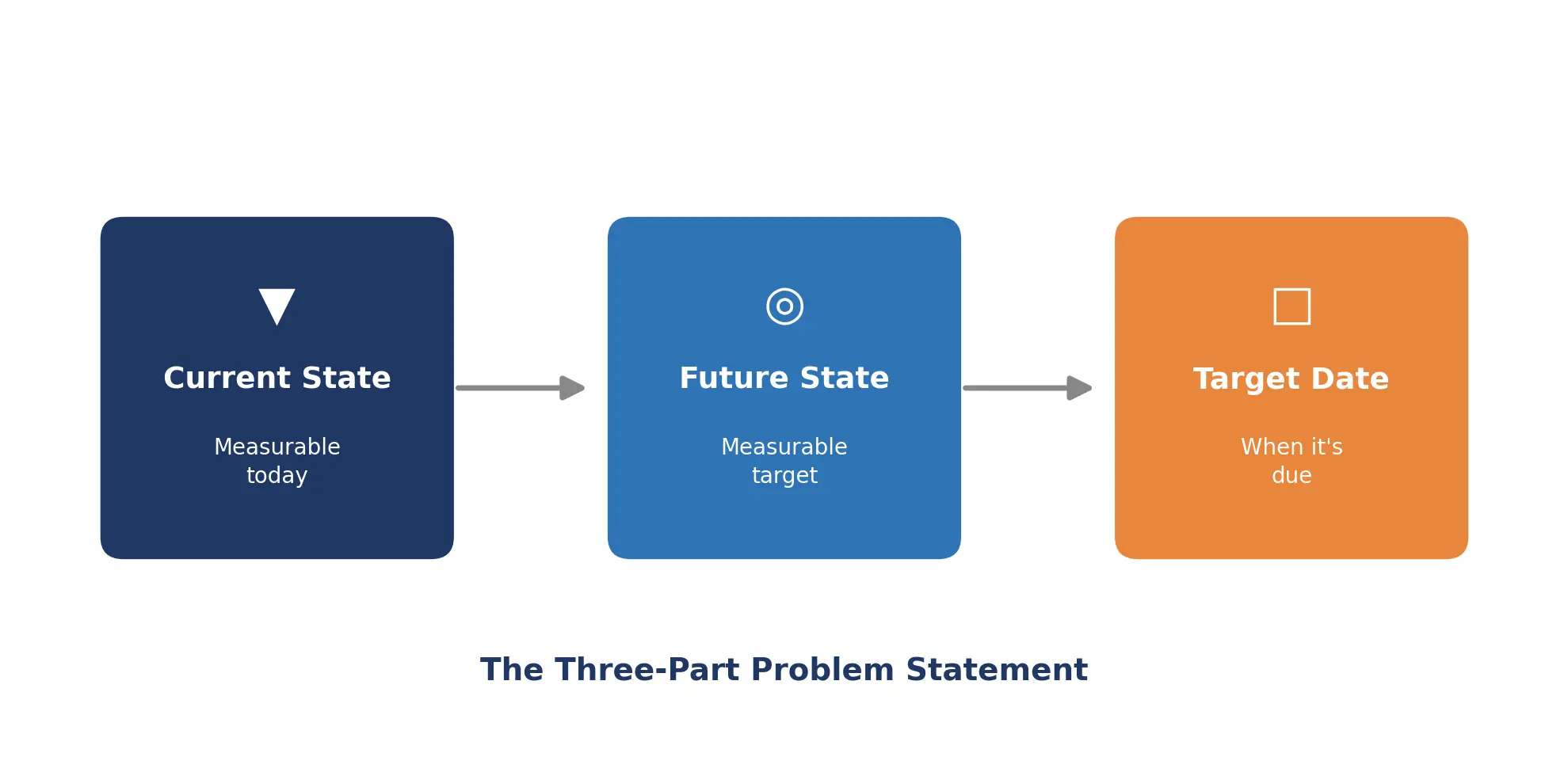
| Component | What it captures | Example |
|---|---|---|
| Current State | The present situation, described with a measurable indicator — cost, time, quality, satisfaction, or volume | “Customer support tickets currently take an average of 36 hours to resolve” |
| Future State | The envisioned target, defined by a measurable goal tied to a real business need or standard | “…compared to our target of 12 hours…” |
| Target Date | A specific date that creates urgency and a point of accountability | “…which we aim to achieve by the end of Q2 2027.” |
Put together as a template you can reuse directly:
Currently, [describe the issue in measurable terms], compared to our target of [describe the ideal state in measurable terms], which we aim to achieve by [target date].
Worked Examples
Weak version: “Our onboarding process is slow and frustrating for new employees.”
This names a feeling, not a measurable gap — there’s nothing here a sponsor can approve a budget against, because there’s no way to know if the project succeeded.
Strong version: “New-hire onboarding currently takes an average of 21 days from offer acceptance to full system access, compared to the HR target of 7 days, which we aim to achieve by the end of this fiscal year.”
Same underlying problem, but now it’s specific enough to scope a project around, measurable enough to prove success against, and urgent enough (a stated deadline) to get sponsor attention.
A second example, IT-context: “System downtime during peak hours currently averages 4.2 hours per month, resulting in an estimated ₹18 lakh in lost transaction revenue, compared to our SLA target of under 1 hour per month, which we aim to achieve within two release cycles.”
What to Include — and What to Leave Out
Do consider:
- The specific problem that needs resolving, stated in one focus area — not several bundled together
- The pain points the problem is causing, and to whom
- Where the problem shows up — which location, team, product, or process
- The stakeholders affected, directly and indirectly
- When the problem was first observed, and how often it recurs
Don’t:
- Tackle more than one problem in a single statement — bundling issues makes scope impossible to define cleanly
- Presuppose a cause before you’ve investigated one
- Assign blame to a person, team, or department
- Propose a solution — that’s the job of the business case or charter that follows, not the problem statement itself
- Get lost in technical complexity the sponsor doesn’t need to approve the project
- Stay vague or use unmeasurable language (“significant,” “many,” “often”)
That last point is the one most drafts fail on. “Often” and “significant” can’t be measured, which means they can’t be proven true or false at project close — and a problem statement that can’t be evaluated isn’t actually doing its job.
Where the Data Comes From
A problem statement is only as credible as the evidence behind it. Before you write one, gather data through whichever of these fit your situation:
- Stakeholder interviews — useful for framing “how it’s being felt,” not just “what the numbers say.” If you haven’t mapped who to talk to yet, our guide on stakeholder identification and prioritization covers the power/interest grid for exactly this.
- Data analysis and historical trend review
- Process mapping, to see where in a workflow the problem actually originates
- Surveys, focus groups, and job shadowing for qualitative texture around a quantitative gap
- Standard operating procedures and compliance requirements, when the “future state” is actually a regulatory or contractual baseline
Problem Statement vs. Root Cause: Don’t Confuse the Two
A common mistake — and a tested exam distinction — is writing a problem statement that already contains a root cause or a proposed fix. “Support tickets take too long because our staffing is inadequate” isn’t a problem statement; it’s a hypothesis wearing a problem statement’s clothes. It presupposes the cause (staffing) before any investigation has happened, and it quietly narrows the solution space before the team has had a chance to look for one.
Root cause analysis — using tools like the 5 Whys or a fishbone (Ishikawa) diagram — comes after the problem statement is agreed on, not before. The sequence matters: agree on the gap first, investigate why it exists second, and propose how to close it third. Skipping straight to cause or solution is the single fastest way to get sponsor pushback, because you’re asking them to approve an explanation they haven’t had a chance to question.
How This Fits Into the Project Charter
Once the problem statement is solid, it feeds directly into the rest of the charter: the business case is built to justify closing exactly that gap, the scope statement is bounded by what’s needed to close it (and nothing more), and success criteria are simply the future state restated as a measurable target at project close. A weak problem statement produces scope creep almost by default, because there’s no clear boundary to test a new request against — if you can’t point to the gap a request closes, it doesn’t belong in scope.
Key Takeaways
- A problem statement has three required parts: current state, future state, and a target date — all stated in measurable terms.
- It never proposes a solution, presupposes a root cause, or assigns blame — those come later in the process, not in the statement itself.
- Vague language (“significant,” “often,” “many”) is the most common weakness — if a claim can’t be measured, it can’t be proven true at project close.
- Root cause analysis (5 Whys, fishbone diagrams) happens after the problem statement is agreed on, never before.
- A strong problem statement is the foundation the rest of the project charter — scope, business case, success criteria — gets built and justified against.
Writing a problem statement is one of the first tested skills in the PMP’s initiating process group. ShriLearning’s PMP online training covers charter development end to end — problem statement, business case, and scope — with worked, exam-style examples. Once you’ve got stakeholders mapped and your charter’s problem statement locked, our interview question guide includes several “tell me about a problem you scoped” prompts interviewers actually use.
FAQs
More for you

Work Breakdown Structure (WBS): The Complete PMP Guide, With a Worked Example
saketpratapsinghdm2026-09-21T16:48:15+05:30September 21st, 2026|
Stakeholder Management and RACI: The Complete PMP Guide (With a Worked Example)
saketpratapsinghdm2026-09-21T15:07:42+05:30September 21st, 2026|
How to Write a Problem Statement (With a PMP-Ready Template and Examples)
saketpratapsinghdm2026-09-21T14:42:27+05:30September 21st, 2026|

Earned Value Management: How to Actually Read CPI and SPI (Not Just Calculate Them)
saketpratapsinghdm2026-09-17T15:32:44+05:30September 17th, 2026|

Agile Practice Guide – Second Edition: What Changed, and What It Means for Your PMI-ACP Prep
saketpratapsinghdm2026-09-17T14:45:53+05:30September 17th, 2026|

Why the PMP People Domain Dropped to 33% (And How to Master It in 2026)
saketpratapsinghdm2026-08-27T21:18:31+05:30August 27th, 2026|

CSM Certification Guide India (2026): Cost, Eligibility, Salary & Exam Steps
saketpratapsinghdm2026-09-17T15:37:52+05:30August 21st, 2026|

Stakeholder Management Plan for PMP: The Complete Guide
saketpratapsinghdm2026-08-21T14:04:07+05:30August 13th, 2026|