Stakeholder Management and RACI: The Complete PMP Guide (With a Worked Example)
Stakeholder Management and RACI: The Complete PMP Guide (With a Worked Example)
Most project managers can sketch a RACI matrix from memory. Four letters, one grid, done in thirty seconds. The grid was never the hard part. The hard part shows up on a live project: priorities shift, two departments both claim the same decision, and someone finds out they got cut out of a call that affected them directly.
Stakeholder management and RACI show up constantly on the PMP exam, and for good reason. PMI’s own research has repeatedly found that unmanaged stakeholder relationships sink projects as often as missed deadlines or blown budgets do. This guide covers both halves properly: how to identify and prioritize stakeholders, and how to build a RACI matrix that survives contact with a real project instead of just looking tidy in a slide deck.
What Is Stakeholder Management?
Stakeholder management means identifying everyone who can affect your project, or who your project affects — then understanding what they need and engaging them so the project delivers value without needless resistance. Stakeholders include sponsors, customers, end users, regulators, vendors, and anyone whose job the project will change, whether or not they sit in your team meetings.
The current PMBOK® Guide treats stakeholder engagement as its own performance domain, not a soft communication add-on. That’s exactly why PMP questions test it as core delivery knowledge, not as a nice-to-have topic.
The discipline rests on four repeatable practices:
- Identify — list everyone who influences the project or feels its effects, directly or indirectly. Keep the list current as the project moves through phases.
- Analyze — assess each stakeholder’s power, interest, and attitude (supportive, neutral, or resistant).
- Plan engagement — decide who to involve, how often, and through which channel.
- Communicate and monitor — keep the right people informed, and revisit the plan whenever roles or priorities shift.
Mapping Stakeholders: The Power/Interest Grid
You can’t manage people you haven’t named, and you can’t engage everyone with equal intensity. A stakeholder map tells you where to spend your limited attention.
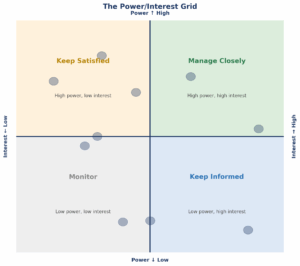
The power/interest grid is the tool most PMP questions reference. It sorts stakeholders into four quadrants:
| Quadrant | Power | Interest | Engagement approach |
|---|---|---|---|
| Manage Closely | High | High | Deep, frequent engagement — these people can make or break the project |
| Keep Satisfied | High | Low | Enough visibility to keep them supportive, without over-communicating |
| Keep Informed | Low | High | Regular updates — they care, even without formal authority |
| Monitor | Low | Low | Light-touch, minimal effort |
The Salience Model: A Finer Cut
Several stakeholders often land in the same quadrant. When that happens, you need a sharper tool. The salience model ranks people by three factors — power, legitimacy, and urgency — so the loudest voice doesn’t automatically win your attention over someone with a genuinely higher stake.
Both tools solve the same underlying problem the work breakdown structure solves for scope: they force you to make something explicit that’s easy to leave implicit. Implicit assumptions are where projects quietly go wrong.
What Is a RACI Matrix?
Once you know who your stakeholders are, RACI settles a narrower, more operational question: for each task or decision, who actually does what?
RACI assigns four roles per task:
| Role | Meaning | Key rule |
|---|---|---|
| R — Responsible | The person (or people) who does the work | Can have multiple people |
| A — Accountable | The single person who owns the outcome and answers for it | Exactly one person, no exceptions |
| C — Consulted | People whose input you seek before finalizing the work | Two-way communication |
| I — Informed | People you update after a decision or milestone | One-way communication |
One rule carries the entire model: every task needs exactly one Accountable person. Several people can share Responsibility; only one can hold Accountability. Two names in the Accountable column guarantees a future argument about whose call it actually was. Zero names guarantees a dropped ball nobody notices until it’s overdue.
The Two Mistakes That Break Most RACI Matrices
Multiple Accountable owners. This usually happens in matrixed organizations, where two functions each partially own an outcome and neither wants to formally cede control. The RACI matrix itself won’t fix this — it just makes the ambiguity visible. The real fix requires a decision from the sponsor, made explicitly and early, before an incident forces it.
Confusing Responsible with Accountable. The person who does the work and the person who answers for the outcome are often the same individual on a small task, but not always. PMP questions specifically test whether you know the difference. A developer can be Responsible for writing code; their engineering manager stays Accountable for it shipping correctly. Collapsing the two roles into one is the single most common RACI mistake in practice.
A Worked RACI Example: Product Launch Communication
Here’s a RACI matrix for a weekly stakeholder communication workflow during a product launch. It’s small enough to read at a glance and realistic enough to adapt directly.
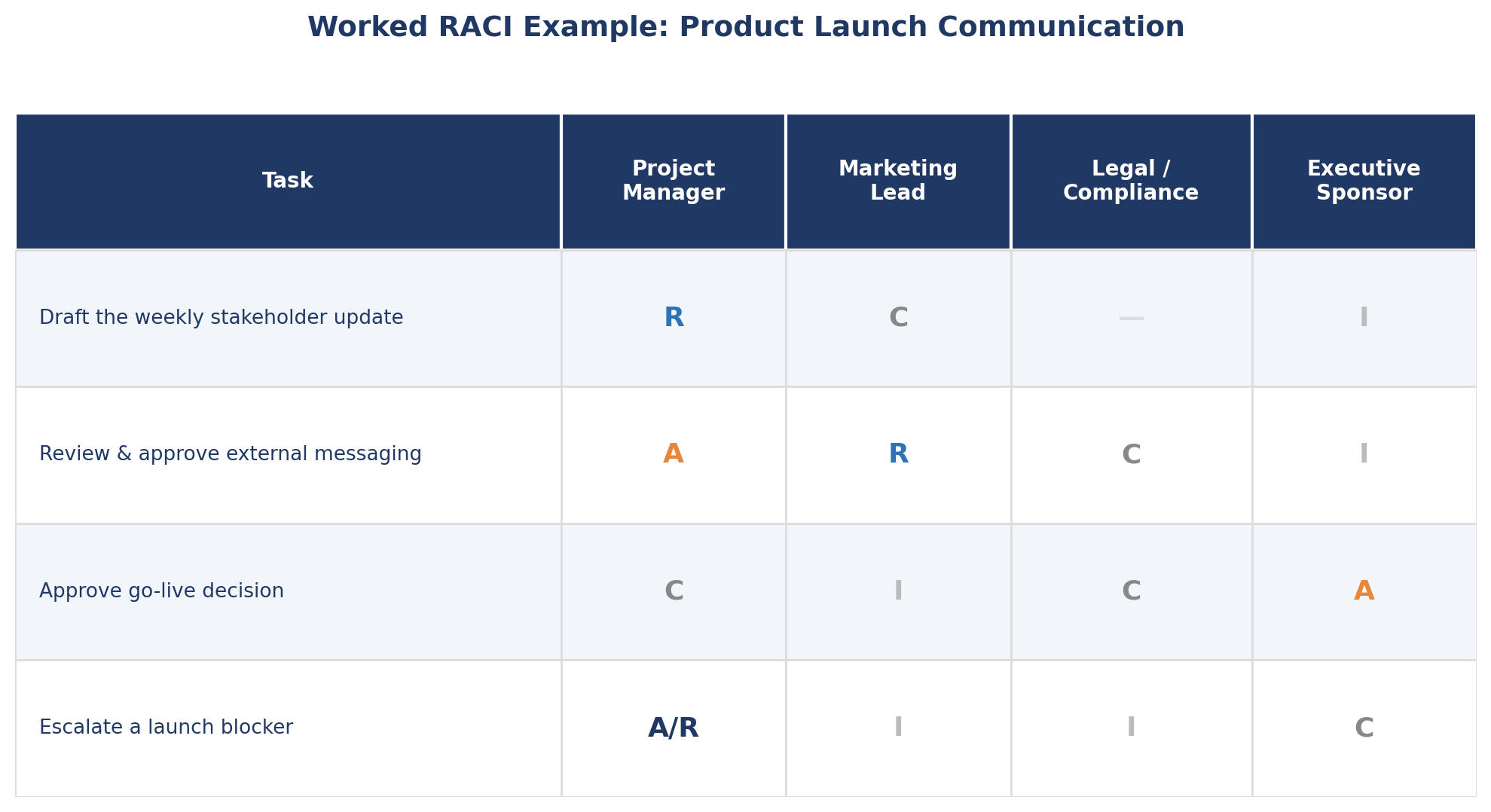
Read this the way an exam question would test it. The Project Manager holds Accountability for escalation, since they own that process. But on the go-live decision, Accountability sits with the Executive Sponsor instead — a reminder that Accountability doesn’t automatically default to the PM just because they’re running the project. Ownership follows authority over the specific outcome, not job title.
RACI vs. the Other Stakeholder Documents PMP Tests
Exam questions frequently test whether you know which document does what. These three get confused constantly:
- Stakeholder register — a list of identified stakeholders and their basic information (contact details, role, assessment data). It answers who.
- Stakeholder engagement assessment matrix — compares each stakeholder’s current engagement level against their desired level, so you can see where a gap needs closing. It answers the gap.
- RACI matrix — assigns specific roles to specific tasks or deliverables. It answers what, for whom.
A stakeholder register can exist without a RACI matrix, and vice versa. They answer different questions. If an exam scenario describes assessing whether a stakeholder is “unaware,” “resistant,” “neutral,” “supportive,” or “leading,” that’s the engagement assessment matrix at work — not RACI.
The PMP Exam Angle: Where Stakeholder Questions Trip People Up
A few patterns show up repeatedly in scenario-based questions on this topic.
“Who should be Accountable?” questions. These test whether you understand that Accountability follows authority over the outcome — not seniority, and not project-management title by default.
Early identification. PMI consistently frames stakeholder identification as continuous, starting at initiation rather than a one-time exercise. A classic wrong-answer trap involves identifying a key stakeholder late in the project.
Conflicting stakeholder interests. This is a favorite scenario setup. The tested answer almost always calls for a win-win resolution through negotiation and communication — not unilaterally favoring the higher-power stakeholder.
Communication method choices. These questions test whether you’d choose push, pull, or interactive communication for a given stakeholder and urgency. The answer connects directly back to the power/interest grid.
If interview prep is next on your list once you’ve got the theory down, our Project Manager Interview Questions guide includes several stakeholder-management scenarios interviewers actually ask.
Key Takeaways
- Stakeholder management and RACI solve two different problems: mapping who matters and how much, then assigning who does what on specific tasks.
- The power/interest grid and salience model are the two tools PMP questions reference most for prioritizing stakeholders.
- RACI’s one non-negotiable rule: exactly one Accountable person per task, never zero, never two.
- Responsible and Accountable get confused constantly, in practice and on the exam — they’re not the same role, even when one person holds both.
- RACI, the stakeholder register, and the engagement assessment matrix answer three different questions. Know which is which.
Preparing for the PMP exam? Stakeholder engagement is a full performance domain in the current framework. ShriLearning’s PMP online training covers RACI construction and stakeholder scenario questions in depth, alongside our work breakdown structure guide for assigning ownership once your scope is defined.
FAQs
More for you

Work Breakdown Structure (WBS): The Complete PMP Guide, With a Worked Example
saketpratapsinghdm2026-09-21T16:48:15+05:30September 21st, 2026|
Stakeholder Management and RACI: The Complete PMP Guide (With a Worked Example)
saketpratapsinghdm2026-09-21T15:07:42+05:30September 21st, 2026|
How to Write a Problem Statement (With a PMP-Ready Template and Examples)
saketpratapsinghdm2026-09-21T14:42:27+05:30September 21st, 2026|

Earned Value Management: How to Actually Read CPI and SPI (Not Just Calculate Them)
saketpratapsinghdm2026-09-17T15:32:44+05:30September 17th, 2026|

Agile Practice Guide – Second Edition: What Changed, and What It Means for Your PMI-ACP Prep
saketpratapsinghdm2026-09-17T14:45:53+05:30September 17th, 2026|

Why the PMP People Domain Dropped to 33% (And How to Master It in 2026)
saketpratapsinghdm2026-08-27T21:18:31+05:30August 27th, 2026|

CSM Certification Guide India (2026): Cost, Eligibility, Salary & Exam Steps
saketpratapsinghdm2026-09-17T15:37:52+05:30August 21st, 2026|

Stakeholder Management Plan for PMP: The Complete Guide
saketpratapsinghdm2026-08-21T14:04:07+05:30August 13th, 2026|