Jobs With PMP Certification in India 2026: Roles, Industries, and Where to Find Them
Jobs With PMP Certification in India 2026: Roles, Industries, and Where to Find Them
Note – Join the ShriLearning Community Connect with fellow PMP aspirants and expert instructors for free.
Most articles on this topic talk about salary numbers and stop there. The more useful question is narrower: which specific jobs, with which specific titles, actually list PMP as a requirement or strong preference on the job posting itself.
The honest answer is that PMP rarely gets you a job you were not already qualified for on paper. What it does is two specific things. It gets your resume past keyword-based applicant tracking systems that many large Indian employers use to filter candidates before a human ever sees the resume. And it signals to a hiring manager, in a single line, that you understand a common vocabulary and framework without needing to explain your process from scratch in the interview.
For roles below the project manager level, PMP is rarely a requirement. For project manager and above, it increasingly shows up as either required or strongly preferred, particularly at multinational companies and larger Indian IT services firms.
Job titles that specifically list PMP as required or preferred
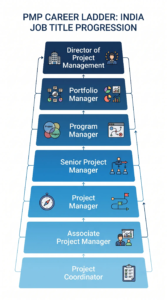
These are the roles where PMP certification appears most frequently in Indian job postings, organized by seniority.
Entry to mid-level roles (0 to 5 years):
Project Coordinator, Associate Project Manager, PMO Analyst, and Junior Project Manager postings sometimes list PMP as a preferred qualification rather than a strict requirement. At this stage, the certification is more of a differentiator among similarly experienced candidates than a gatekeeping requirement.
Mid to senior roles (5 to 12 years):
This is where PMP shows up most consistently as a stated requirement. Project Manager, Senior Project Manager, Technical Project Manager, IT Project Manager, and Delivery Manager postings at IT services companies, consulting firms, and MNCs regularly list PMP as required or as an equivalent-accepted qualification alongside PRINCE2.
Senior and leadership roles (10+ years):
Program Manager, Portfolio Manager, Head of PMO, and Director of Project Management roles often list PMP as a baseline expectation rather than a differentiator. At this level, the certification is assumed, and the interview focuses almost entirely on your actual track record.
Adjacent roles where PMP appears as a plus, not a requirement:
Business Analyst, Scrum Master, Product Owner, and Change Management Specialist postings occasionally mention PMP favorably, particularly when the role involves cross-functional coordination even though project management is not the primary function.
Which industries hire the most PMP certified professionals
PMP certified professionals in India are concentrated in a handful of industries, though the credential is genuinely industry-agnostic.
Information Technology and IT services. This is by far the largest employer of PMP certified professionals in India, driven by the scale of outsourced software delivery, global capability centres, and product development teams that need structured project oversight across distributed, often international teams.
Banking, Financial Services and Insurance (BFSI). Digital transformation projects, core banking system upgrades, and regulatory compliance initiatives in this sector rely heavily on certified project managers who can navigate both technical delivery and stakeholder governance.
Construction and infrastructure. Large infrastructure and real estate development projects have used formal project management practices for decades, and PMP remains a recognized credential in this sector, particularly for professionals managing multi-crore projects with multiple contractors and regulatory approvals.
Manufacturing and engineering. Process improvement initiatives, plant expansions, and product development cycles in manufacturing increasingly value certified project management skills, especially as manufacturing firms adopt more structured digital transformation programs.
Healthcare and pharmaceuticals. Hospital system implementations, pharmaceutical R&D project coordination, and healthcare technology rollouts are a smaller but growing segment where PMP certified professionals are increasingly sought after.
Consulting. Management and technology consulting firms hire PMP certified professionals specifically for client-facing project delivery roles, where the credential also functions as a client-facing trust signal.
Companies that consistently recruit PMP holders in India
Rather than naming specific companies whose hiring patterns change constantly, it is more useful to understand the categories of employers where PMP certification carries the most weight during recruitment.
Global IT services and consulting majors headquartered or with large operations in India consistently list PMP among preferred qualifications for project and program manager roles, given the scale of global delivery they manage.
Multinational corporations with India-based global capability centres (common in Bengaluru, Hyderabad, Pune, and the Delhi NCR region) frequently require PMP for project management roles, since these roles often coordinate directly with international stakeholders who expect a shared PM vocabulary.
Large Indian conglomerates in infrastructure, manufacturing, and engineering increasingly list PMP as a preferred qualification for senior project roles, reflecting a broader shift toward internationally recognized project management standards.
Government and public sector infrastructure bodies in select large-scale projects have also begun preferring PMP certified project leads, particularly for projects involving international funding or multinational contractor coordination.
The most reliable way to identify current hiring patterns is to search PMP as a keyword directly on LinkedIn Jobs or Naukri filtered by your city and target industry, since specific hiring volume shifts month to month.
The career path from certification to senior roles
PMP certification does not fast-track you to a senior role by itself, but it does shape how quickly a typical career progression can move.
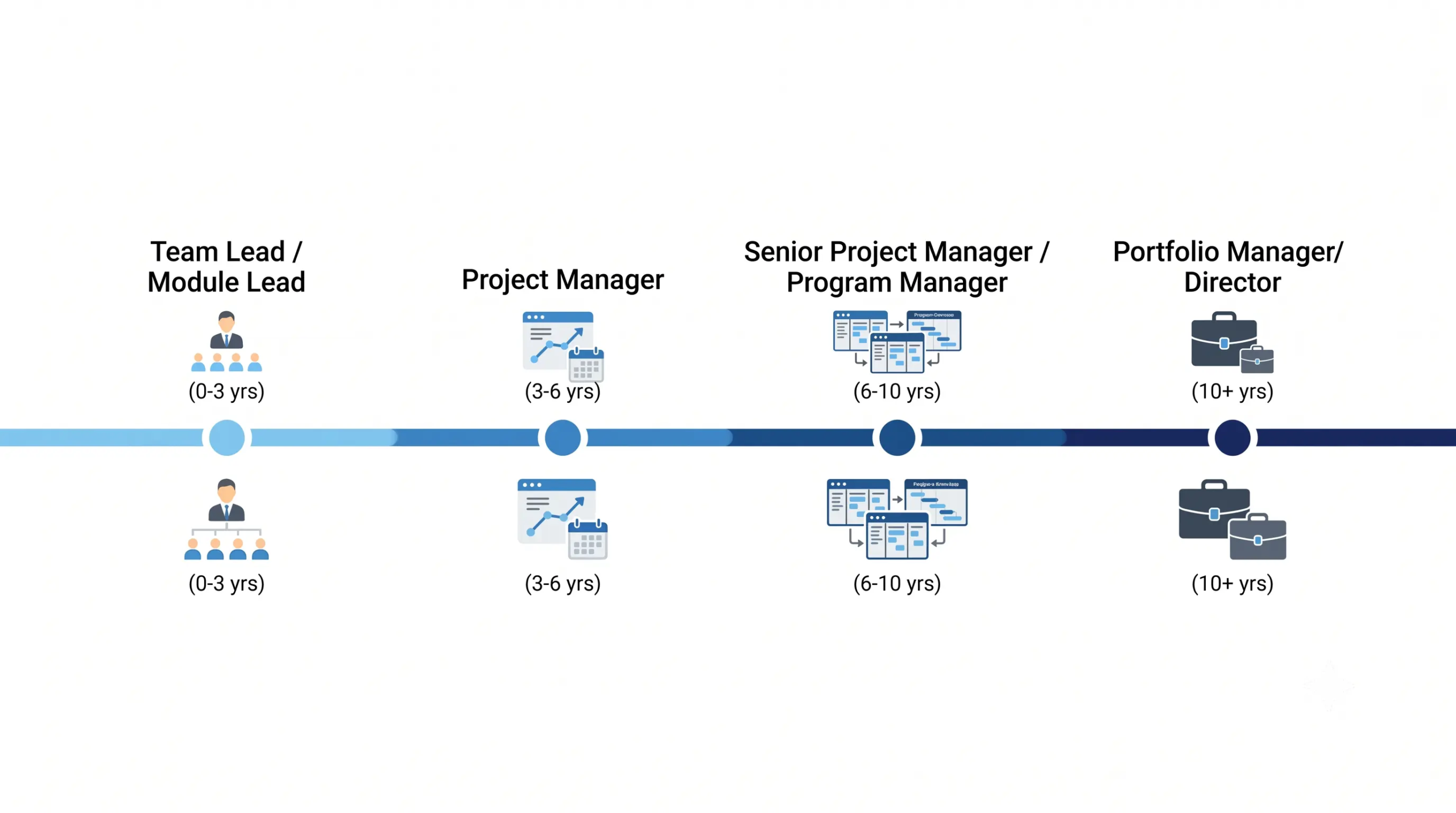
A common trajectory among PMP certified professionals in India looks like this. Professionals with 2 to 4 years of experience who earn PMP often see it help them move from a Team Lead or Module Lead title into a formal Project Manager title, sometimes within the same organization during an internal promotion cycle rather than requiring a job change.
At the 5 to 8 year mark, PMP certified Project Managers frequently use the credential alongside a strong delivery track record to move into Senior Project Manager or Program Manager roles, particularly at organizations managing multiple concurrent projects or larger, multi-team initiatives.
Beyond 10 years, PMP tends to function less as a career accelerant and more as an expected baseline credential for Portfolio Manager, Head of PMO, or Director-level project leadership roles, where the actual hiring decision weighs heavily on demonstrated leadership and business outcomes.
How to position your PMP on your resume and LinkedIn
A few practical, specific points that make a genuine difference in how recruiters and applicant tracking systems process your PMP credential.
Put PMP in your headline, not just your credentials section. On LinkedIn specifically, having “PMP” directly in your headline (for example, “Senior Project Manager, PMP” ) increases visibility in recruiter searches that filter by keyword.
List your PMI ID number if the job application allows it. Some larger organizations verify credentials directly against PMI’s registry during the hiring process. Having your certification ID ready speeds this up.
Quantify outcomes near your PMP mention, not just responsibilities. A resume line like “PMP certified; led cross-functional team of 12 delivering a Rs. 4 crore infrastructure upgrade 3 weeks ahead of schedule” does far more work than listing PMP as a standalone bullet point.
Mention your specific methodology experience alongside PMP. Since the current PMP exam itself covers predictive, agile, and hybrid approaches in roughly equal weight, naming your practical experience with Agile, Scrum, or hybrid delivery alongside your PMP credential signals current, relevant capability rather than a credential earned in isolation from practice.
Related reading on ShriLearning:
- PMP Certification in India 2026: Cost, Eligibility & How to Apply
- Best PMP Trainer in India 2026
- How Long Does It Take to Get PMP Certified?
- PMP Exam Fee in India 2026: Complete INR Breakdown
Your first project is calling—will you answer? Join the ShriLearning Community Connect with fellow PMP aspirants and expert instructors. Crete your study plan for free from ShriLearning study-plan-generator.
FAQs
More for you
Benefits of Agile Project Management for Small and Medium-Sized Businesses
saketpratapsinghdm2026-09-28T10:12:30+05:30September 28th, 2026|

Work Breakdown Structure (WBS): The Complete PMP Guide, With a Worked Example
saketpratapsinghdm2026-09-21T16:48:15+05:30September 21st, 2026|
Stakeholder Management and RACI: The Complete PMP Guide (With a Worked Example)
saketpratapsinghdm2026-09-21T15:07:42+05:30September 21st, 2026|
How to Write a Problem Statement (With a PMP-Ready Template and Examples)
saketpratapsinghdm2026-09-21T14:42:27+05:30September 21st, 2026|

Earned Value Management: How to Actually Read CPI and SPI (Not Just Calculate Them)
saketpratapsinghdm2026-09-17T15:32:44+05:30September 17th, 2026|

Agile Practice Guide – Second Edition: What Changed, and What It Means for Your PMI-ACP Prep
saketpratapsinghdm2026-09-17T14:45:53+05:30September 17th, 2026|

Why the PMP People Domain Dropped to 33% (And How to Master It in 2026)
saketpratapsinghdm2026-08-27T21:18:31+05:30August 27th, 2026|

CSM Certification Guide India (2026): Cost, Eligibility, Salary & Exam Steps
saketpratapsinghdm2026-09-17T15:37:52+05:30August 21st, 2026|