PMP Formulas Cheat Sheet 2026: All 15 Formulas
PMP Formulas Cheat Sheet 2026: All 15 Formulas
Let’s address the elephant in the room: Project managers are leaders, not human calculators. Yet, when aspirants start their exam preparation, they often encounter massive study guides filled with terrifying, complex algebraic equations. They see acronyms like PTA, PERT, EAC, and TCPI. Panic immediately sets in. They assume they will spend four hours doing long division at a testing center.
At ShriLearning, we have mentored thousands of students who were convinced they would fail the Project Management Professional (PMP)® exam simply because they were “bad at math.”
We always tell them the exact same thing: You are studying for the wrong exam.
The 2026 PMP exam does not care if you can perform complex arithmetic. It cares if you can interpret data to make strategic leadership decisions. While you do need to know a specific set of formulas, you will rarely need to calculate them down to the final decimal.
To save you from memorizing useless equations, we have cross-verified the current Project Management Institute (PMI) standards to build the ultimate, definitive master guide. We didn’t just list the formulas; we translated them into conversational, real-world logic so you know exactly why they exist and how to use them.
Here is the only PMP formulas cheat sheet you actually need to pass the exam in 2026.
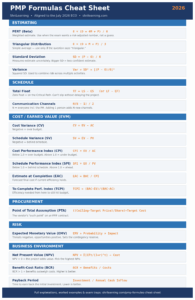
1. The Reality of PMP Math in 2026
Do I need a physical calculator for the PMP exam?
No. You are not allowed to bring a physical calculator into the testing center. The Pearson VUE exam software provides a built-in digital calculator on the screen. However, for the majority of modern exam questions, you will not even need to open it.
How is math tested on the 2026 exam?
The modern PMP exam tests interpretation over calculation.
In the past, a question might ask you to calculate the exact Schedule Performance Index (SPI) using a complex word problem. Today, the exam simply gives you the SPI (for example, SPI = 0.8) and asks you a situational question: “Your SPI is 0.8. What should the project manager do next?”
You must know that a number below 1.0 is bad, meaning you are behind schedule, and you must select the answer that involves corrective action. Let’s break down the structural formulas you still need to understand to make those critical decisions.
2. Estimating: PERT & Three-Point Formulas
When you are planning a project, stakeholders will ask, “How long will this take?” Giving a single guess is incredibly dangerous. Three-Point estimating uses multiple scenarios to create a highly accurate, risk-adjusted estimate.
Beta Distribution (PERT)
You will use this formula when the exam asks you to calculate a “PERT estimate” or a “Beta distribution.” This is the most accurate way to estimate time or cost because it heavily weights the most realistic scenario, while still factoring in extreme risks.
Formula: E = (O + 4M + P) / 6
To understand this, we need to look at the anatomy of the letters. E is the expected, highly accurate estimate you are trying to find. O is the optimistic, absolute best-case scenario where everything goes perfectly. M is the most likely scenario, representing how long the work usually takes. Finally, P is the pessimistic, worst-case scenario where all your risks actually happen.
Think of this formula like a voting system with 6 total votes. Because the “Most Likely” (M) scenario is the most realistic, we give it 4 votes. We give the “Optimistic” (O) scenario 1 vote, and the “Pessimistic” (P) scenario 1 vote. Since we cast 6 total votes, we divide the entire sum by 6 to get the true, weighted average.
You will need this on the exam when a situational question states that a sponsor wants a highly accurate estimate that accounts for risk, rather than just a simple average.
Let’s look at an exam scenario: Imagine you are estimating how long it will take to code a new software feature. If everything goes perfectly, it will take 2 days (O). If the servers crash, it could take 14 days (P). Realistically, it usually takes 4 days (M).
To find your PERT estimate, you multiply your most likely scenario by 4 (4 x 4 = 16). Then, you add your optimistic and pessimistic numbers (2 + 16 + 14 = 32). Finally, you divide that total by 6. The result is 5.33 Days. Instead of just guessing “4 days” and being late when a risk happens, you tell the sponsor it will take 5.33 days, giving your team a mathematical safety buffer.
(Note: If the exam specifically asks for a “Triangular” distribution, you skip the weighting and do a simple average instead: E = (O + M + P) / 3).
3. Stakeholders: Communication Channels
As you add more people to a project, the complexity of communication does not grow linearly; it grows exponentially. This formula calculates the total number of potential communication pathways that exist.
Formula: Channels = N(N – 1) / 2
In this equation, N represents the total number of stakeholders on the project team.
To visualize this, think of a dinner party. With 3 people at the table, it is easy to have one shared conversation. With 10 people at the table, there are 45 different side-conversations happening at once. This formula tells you exactly how chaotic your communications are getting so you can plan your meetings and reports accordingly.
There is a major trap on the exam regarding this formula. You must always include the Project Manager in the count. If a question says, “You have a team of 4 developers and 2 testers,” N does not equal 6. You must add yourself (the PM), making N = 7.
Let’s look at an exam scenario: You are the project manager for a team of 5 people. A new specialist joins the team today. How many new communication channels were created?
First, find the old channels. The old team was 5 people plus 1 PM, making N = 6. Using the formula, 6(5) / 2 = 15 channels. Next, find the new channels. The team adds a specialist, making N = 7. Using the formula, 7(6) / 2 = 21 channels. The difference between the two is 6. Adding just one single person created 6 entirely new communication pathways that you now have to manage.
4. Scheduling: Total Float & Critical Path
If you are managing a complex schedule, you need to know exactly which tasks can be delayed and which ones cannot.
Formula: Total Float = LS – ES (Late Start minus Early Start) OR LF – EF (Late Finish minus Early Finish)
LS is the absolute latest a task can start without delaying the whole project, while ES is the earliest it can possibly start.
This formula simply answers the question: “How many days can this specific task be delayed before it ruins my final delivery date?” If the answer is zero, this task has zero float. That means it is on the Critical Path and cannot slip by even one minute without pushing the entire project off track.
The PMP exam tests your understanding of schedule risk using this concept. For example, if a task has 10 days of float, and a vendor is going to be 3 days late delivering a part for that task, do you need to submit a Change Request to extend the project deadline? No. You simply absorb the 3-day delay using the 10 days of available float.
5. Procurement: Point of Total Assumption (PTA)
This formula applies strictly to Fixed Price Incentive Fee (FPIF) contracts.
Formula: PTA = ((Ceiling Price – Target Price) / Buyer’s Share Ratio) + Target Cost
To break this down, the Target Cost is what you expect the work to actually cost. The Target Price is that cost plus the vendor’s expected profit. The Ceiling Price is the absolute maximum the buyer will ever pay. Finally, the Share Ratio is expressed as a fraction (like 80/20), where the buyer’s share is the first number (0.80).
In real-world terms, this is the financial “Ouch Point” for the vendor. Once the project costs hit this specific number, the vendor stops sharing the financial pain with the buyer and has to pay for every single mistake out of their own pocket. Their profit is entirely gone.
You rarely have to calculate this on the modern exam, but you must understand the psychology behind it. If a vendor reaches the PTA, they are actively losing money. They will likely try to cut corners, use cheaper materials, or rush the work. The Project Manager’s immediate action must be to increase quality control and monitoring to ensure the product doesn’t suffer.
6. Risk Management: Expected Monetary Value (EMV)
Expected Monetary Value assigns a specific dollar amount to a risk. It is heavily used in quantitative risk analysis to help you build an accurate contingency budget.
Formula: EMV = Probability x Impact
Probability is the percentage chance the risk will happen (like 20% or 0.20). Impact is the dollar amount it will cost or save. Threats use negative numbers, while opportunities use positive numbers.
The logic here is simple: you cannot put $50,000 in your budget for a storm that only has a 20% chance of happening. That locks up too much company money unnecessarily. You need to multiply the chance by the cost to find a mathematically fair amount to save for a rainy day.
Let’s look at an exam scenario: There is a 20% chance that a storm will delay your shipment, causing a $50,000 penalty. What is the EMV? You multiply 0.20 by -$50,000, which equals -$10,000. To establish a proper, risk-adjusted contingency reserve for this specific event, you should set aside exactly $10,000 in your budget.
You’re very unlikely to be handed a multi-year discounted cash flow table and asked to compute NPV by hand. You’re much more likely to be given two completed NPV or BCR figures and asked which project to select — so focus on “higher NPV wins” and “BCR above 1.0 is worth doing,” not the arithmetic.
7. The EVM Refresher: Interpreting SPI & CPI
While ShriLearning has a massive, dedicated deep-dive article on Earned Value Management (EVM), no master cheat sheet is complete without the core interpretation metrics.
As stated earlier, the 2026 exam wants you to read the dashboard, not build the dashboard. Memorize these conversational translation rules:
| Metric | Formula | The Real-World Translation for the PMP Exam |
| Cost Variance (CV) | EV – AC | Negative: We are bleeding money.
Positive: We are saving money. |
| Schedule Variance (SV) | EV – PV | Negative: We are behind schedule.
Positive: We are ahead of schedule. |
| Cost Performance Index (CPI) | EV / AC | Less than 1.0 (e.g., 0.8): For every dollar we spend, we get 80 cents of value. We are over budget.
Greater than 1.0: We are highly efficient and under budget. |
| Schedule Performance Index (SPI) | EV / PV | Less than 1.0 (e.g., 0.8): We are working at 80% of the speed we promised. We are delayed.
Greater than 1.0: We are working faster than expected. |
(Note: EV = Earned Value, PV = Planned Value, AC = Actual Cost)
The Ultimate Shortcut: If a variance (CV, SV) is negative, it is bad. If an index (CPI, SPI) is under 1.0, it is bad. If you memorize that single rule, you can correctly answer 90% of the EVM situational questions on the exam.
Passing the PMP exam requires you to step away from rote memorization and embrace situational logic.
If you spend three weeks memorizing the PTA formula but do not understand why a vendor’s behavior changes when they run out of profit, you will fail the situational procurement questions. The math is simply a tool to help you make human leadership decisions.
At ShriLearning, our training philosophy strips away the unnecessary academic fluff. We do not force our students to memorize complex equations that are no longer tested.
When you join our PMP Mentorship Program, we teach you how to read the data like a C-Suite executive. We provide streamlined, easy-to-understand frameworks just like this one, and we train you specifically on how to spot the mathematical trap answers in the Pearson VUE exam simulator.
Keep advancing in your PMP journey — explore our other in-depth guides
- 2026 PMP Exam Changes: The “Practicum” Revolution & Why 4 Hours Changes Everything
- The 2026 PMP Exam Shift: How to Master the “Business Environment” Surge (8% to 26%)
- The 5 Scrum Events Explained: Purpose, Attendees, and Effective Execution
- Why PMP Aspirants Fail? – And How to Avoid Them
- Why You Should Track Your Errors — and How to Do It Right
Your first project is calling—will you answer? Join the ShriLearning Community Connect with fellow PMP aspirants and expert instructors. Crete your study plan for free from ShriLearning study-plan-generator.
FAQs
More for you
Benefits of Agile Project Management for Small and Medium-Sized Businesses
saketpratapsinghdm2026-09-28T10:12:30+05:30September 28th, 2026|

Work Breakdown Structure (WBS): The Complete PMP Guide, With a Worked Example
saketpratapsinghdm2026-09-21T16:48:15+05:30September 21st, 2026|
Stakeholder Management and RACI: The Complete PMP Guide (With a Worked Example)
saketpratapsinghdm2026-09-21T15:07:42+05:30September 21st, 2026|
How to Write a Problem Statement (With a PMP-Ready Template and Examples)
saketpratapsinghdm2026-09-21T14:42:27+05:30September 21st, 2026|

Earned Value Management: How to Actually Read CPI and SPI (Not Just Calculate Them)
saketpratapsinghdm2026-09-17T15:32:44+05:30September 17th, 2026|

Agile Practice Guide – Second Edition: What Changed, and What It Means for Your PMI-ACP Prep
saketpratapsinghdm2026-09-17T14:45:53+05:30September 17th, 2026|

Why the PMP People Domain Dropped to 33% (And How to Master It in 2026)
saketpratapsinghdm2026-08-27T21:18:31+05:30August 27th, 2026|

CSM Certification Guide India (2026): Cost, Eligibility, Salary & Exam Steps
saketpratapsinghdm2026-09-17T15:37:52+05:30August 21st, 2026|