SAFe vs Agile: Differentiation Between The Scaled Agile and The Agile
SAFe vs Agile: Differentiation Between The Scaled Agile and The Agile
It was about a proportionately short time ago that the traditional waterfall method of project management was the only path to take. And while it performed efficiently for most of the projects – especially ones which were regarded as ‘predictive’ – it didn’t perform so well for those we call adaptive. And then, over the last 20 years, and moreover the past 10 or so, the agile methodology has been progressively used in projects, mainly software-based ones. The Leading SAFe certification is so helpful for you in mastering the purpose of a scrum master and coaching you to pass the exam in a single take. Let’s begin with the differentiation table of SAFe Agile and Agile!
SAFe Agile vs Agile Framework [Head-to-Head Differentiation]
Find out the differences between Scaled Agile and Agile Framework in the comparison table below:
| Parameter | SAFe Agile | Agile |
| 1. Scale of application | Designed for the large-scale enterprise projects | Designed for medium and small-scale projects |
| 2. Flexibility | It has structured scaling with balanced flexibility | Adaptive and highly flexible |
| 3. Project Planning | Incremental, and iterative planning that is synchronized at scale | Iterative planning within short cycles |
| 4. Organizational structure | Introduces roles and structure | Enhances self-organized teams |
| 5. Lean-Agile Principles | Grows on Agile principles, coordinates with the lean principles for organizational efficiency | Cling to the Agile manifesto |
| 6. Cadence of Releases | Coordinated releases for a larger impact with the aligned teams | Small, frequent releases |
| 7. Decision-making | Structured decision making at scale for alignment | Decisions are made co-operatively within the teams |
| 8. Communication | Structured communication ideas for larger teams | Priority on informal communication inside the teams |
What is the meaning of Agile?
As per the Agile Alliance, the meaning of Agile is the capability to create and react to the changes around. It is one of the ways of handling and eventually succeeding in a turbulent and uncertain environment.
It is a collection of principles and values as shown in the Agile Manifesto. Although it can also be applied to various projects, it primarily refers to a set of perspectives on software development that utilize incremental (consecutively added functionality) and iterative (repeated processes).
The Agile Manifesto suggests that:
We are discovering better ideas for developing software by implementing it and serving others to do it. By this work, we reached the value:
- Individuals and interactions on the tools and processes
- Working software through comprehensive documentation
- Collaboration with customers over contract negotiation
- Reacting to change instead of following a plan
This implies that, while there is worth in the items that are to the right, we value all the items that are on the left better.
There is also a fundamental collection of twelve principles. The starting two principles imply that “our highest preference is to fulfill the customer through continuous and early delivery of beneficial software” and also that we “accept changing requirements, even though it is late in improvement. Agile processes control change for the competitive advantage of the customers.”
A few of the most common Agile methodologies will include Feature-Driven Development (FDD), Kanban, Extreme Programming ( XP), and Scrum. Among these, Scrum is the one that, by all accounts, is the most popular, hence we will discuss and concentrate there.
For the most of it, all kinds of Agile methodologies will have a few things that are in common – they mostly use timeboxes, which the Agile Alliance states as a previously accepted time period during which a team or a person works consistently towards the completion of some objective.”
They engage in iterations to improve the product via a series of iterative cycles and increments that are consecutively added to the product’s functionality. The graphic which is below displays the process of Agile Scrum.

Ultimately a sprint – or timebox – the whole Scrum team is responsible for producing a useful, valuable increment. Frequent interactions with mini batches of work, stakeholders, retrospectives, and regular reviews upgrade the process and consequently, the product.
Read around 5 whys root cause analysis in teams of the agile, along with its success factors and approaches, in our blog posts
What is the meaning of SAFe?
As specified above, Agile was created for very small teams, and the SAFe® was outlined to scale to different levels, from important to complete SAFE®. It is based on the foundation of Agile and builds on it.
Cprime published one of the reports known as Agile at Scale 2020. This report was built on a valid survey of different organizations that are expanding Agile over small teams and frequently to the organization. The developmental teams’ size varied from <50 (32%) to a surprising 1001+ (18.4%).
The same study reveals that the leading framework at “Scrum only” remains at 24% while 34% is SAFe®. This kind of study doesn’t delve deeper into these numbers, however, it’s still practical to consider that as organizations expand into the enterprise, they need something more comprehensive than Scrum alone.
SAFe® for the Lean Enterprises is the knowledge base of integrated, proven practices, principles, and competencies for attaining business agility with the use of Agile, DevOps, and Lean. It includes many levels to which you can expand:
- Essential SAFE® – it includes the minimum collection of artifacts, events, and roles needed to deliver business solutions continuously through the Agile Release Train (ART) like a Team of all the Agile Teams.
- Large Solution SAFe®– it describes extra guidance, practices, and roles to build and develop the world’s biggest cyber-physical systems, networks, and applications. It includes an extra competency known as Enterprise Solution Delivery.
- Portfolio SAFe®– it lines up strategy with the execution, and it organizes solution improvement throughout the flow of the value via single or multiple value streams. It is one of the tiniest configurations that could be used to accomplish Business Agility, and it adds the basic competencies of Organizational Agility, Continuous Learning Culture, and Lean Portfolio Management.
- Full SAFe®– it shows the most extensive configuration. It helps build integrated, large solutions that typically need hundreds of human resources to develop and handle.
Differentiation Between Agile and SAFe Agile [In-Depth Comparison]
The primary variation between Agile and the SAFe Agile lies in their application and scope. Let us understand them deeply.
Agile vs SAFe Agile: The scale of Application
- Agile, along with its deep roots in almost all small to mid-sized projects, stands out in providing quick adaptations and flexibility. Nevertheless, we might face some challenges while scaling Agile to fulfill the requirements of large-scale enterprises.
- SAFe Agile, in contrast, accelerates to the plate by offering a well-structured framework that is designed exclusively for the difficulties of large-scale projects.
Agile vs SAFe: Its flexibility
- The flexibility built into Agile permits teams to adapt quickly in response to the varying requirements. This adaptability encourages a cooperative environment where modifications are ideally made.
- SAFe Agile, while it is still flexible, maintains a balance by establishing a more well-structured framework that makes sure alignment among the teams while handling adaptability.
Agile vs Scaled Agile: The Organizational Structure
- The principles of Agile highlight self-organizing teams, encouraging a culture of autonomy and collaboration.
- On the other hand, SAFe Agile establishes a structure with properly defined roles. This well-structured approach aims to streamline decision-making and communication in large-scale enterprise environments.
SAFe Agile vs Agile: The Project Planning
- The project planning of Agile includes iterative cycles, permitting for fast improvements and adjustments. This perspective facilitates short-term adaptability and planning.
- On the other hand, SAFe Agile combines incremental and iterative planning, integrating efforts across various teams. This synchronized planning makes sure that every increment aligns with the large-scale enterprise objectives.
Scaled Agile vs Agile: The Communication
- Agile projects flourished on frequent and informal communication within the self-organizing teams.
- On the other hand, the SAFe Agile requires communication plans to become more well-structured, necessitating extensive plans to make information flow easily among the large and distributed teams. The extra documentation makes sure that each and every one is in agreement in the scaled environment.
Agile vs SAFe Agile: The Decision-Making
- Agile authorizes teams to make their own decisions together, utilizing the collective intelligence and knowledge of the group.
- SAFe Agile introduces well-structured decision-making to put in order the decisions with the wider objectives of the company. This ensures that every member is in accordance across a variety of teams and motivates a team effort regarding the achievement of the project objectives.
Agile vs SAFe Agile: The Cadence of Releases
- Agile champions regular and small releases, granting quick adjustments and continuous feedback.
- On the other hand, in SAFe Agile, the releases are coordinated over various teams by making sure that every release corresponds with the strategic objectives of the business. This simultaneous cadence improves the influence of the product delivered.
Agile vs SAFe Agile: The Lean-Agile Principles
- Although Agile complies with the Agile Manifesto principles, SAFe Agile elaborates on those principles. It combines Lean-Agile principles, highlights efficiency, enhances resources, and removes waste.
- This wide framework focuses on delivering not only single project achievement but also entire organizational efficiency.
Important Roles that are in the Scrum Variant of Agile
This Scrum variant describes three vital roles:
- The Product Owner instructs the task for a composite issue into the Product Backlog. The Product owner is even responsible for expanding and clearly conveying the Product objective, managing the items of a product backlog, and making sure that the Backlog has been understood, visible, and transparent.
- The Scrum (or the Development) Team rotates the choice of the task into the increment of the value at the time of the Sprint. The Scrum (development) Team and Scrum’s stakeholders examine the outcomes and adapt for the upcoming Sprint. They are self-organizing, cross-functional, and determine the way to carry on the work.
- The Scrum Master has been responsible for the effectiveness of the Scrum Team. They carry on this by allowing the Team to enhance its practices, and by eliminating impediments within the framework of Scrum.
Scrum utilizes various “ceremonies” or events to determine progress regarding the sprint objective and helps to acquire the backlog (the items that must be worked on) as required:
- Daily Scrum – The main purpose of these 15 minutes of the Daily Scrum will be to determine progress regarding the Sprint Objective and acquire the Sprint Backlog when needed, by adjusting the forthcoming planned work.
- Sprint Review – The main purpose of this Sprint Review will be to determine the result of the particular Sprint and regulate upcoming modifications. The Scrum Team introduces the outcome of their ongoing work to stakeholders, and advancing toward the Product objective will be discussed.
- Retrospective – The main need for this Sprint Retrospective will be to decide the ways to improve effectiveness and quality. The Scrum Team determines how the previous Sprint went, considering tools, processes, interactions, individuals, and its Definition of Done.
Rather than control and command as rehearsed in the traditional waterfall methodology, agile engages servant leadership which has been a practice and philosophy of leadership built on community building, commitment, stewardship, foresight, conceptualization, persuasion, awareness, healing, empathy, and listening
SAFe Agile Essential Roles [Derived on Levels]
The SAFe® structure has several types of defined roles similar to Agile, some of which depend on the extent to which one desires.
Vital SAFe® Roles at the important level
The vital SAFe roles including their main roles at the important level are:
- Product Owner – The Product Owner is responsible for organizing the stories and making sure that they are understood and well-described. To successfully manage the SAFe product owner responsibility and collaborate effectively with the team members to deliver essential products, participating in SAFe courses is recommended.
- Scrum Master – The Scrum Master is responsible for making sure that the team works efficiently and follows the proper processes.
- Agile Teams – They are responsible for the quality of the task undertaken and the delivery.
- Release Train Engineer – They are responsible for making sure that an agile release train (the team of the agile teams) performs better together and proceeds with further processes.
- Product Manager – The Product Manager is responsible for organizing the features and making sure that they are understood and well described.
- System Engineer/Architect – They are responsible for sharing and designing the architectural vision over an agile release train. This implies that the work delivered is fit for the purpose.
- Business Owners – The key stakeholders who will be eventually in charge of the business results.
Key SAFe roles and responsibilities at the Large Solution level
The vital SAFe® roles and their main responsibilities at the huge solution level comprise all the above and:
- The Solution Train Engineer (STE) – The STE is a coach and servant leader for a Solution Train, by guiding and facilitating the work of Suppliers and ARTs in a Value Stream.
- Solution Management – responsible for supporting and defining the building of sustainable, viable, feasible, and desirable large-scale business results that fulfill customer requirements within the timeline.
- Solution Engineer/Architect – is responsible for sharing and designing the architectural vision over various agile release trains. This means the outcomes delivered are fit for the need.
- Customer – They consume the outcome from an agile release train. It could be people inthe organization or external customers. The customers are known as the people who have the final say on whether the outcome was valuable.
Key SAFe roles in the Portfolio level
The vital SAFe® roles in the portfolio level include:
- Full SAFe® doesn’t have any new defined roles.
- Enterprise Architect – drives the architectural creativity for the portfolio.
- Epic Owners – They are responsible for describing an epic, articulating the benefits, and aiding its implementation.
Planning
While both Agile and Scrum plan their type of work at the initial stage of every sprint, SAFe has a distinctive event, known as Program Increment. A key factor of this type is the ART (Agile Release Train), a long-term team of the Agile teams that, including other deliveries, incrementally develops, stakeholders, and, where applicable, works with one or more answers in the value stream.
The PI (Program Increment) has been the timebox through which an ART supplies the incremental value much like the working, tested systems, and software. PIs are usually 8–12 weeks long.
Typically, there have been four main development Iterations, that is followed by one IP (Innovation and Planning) Iteration. A Program Increment (PI) is to an ART (Agile Release Train) or a Solution Train, while the iteration is to an Agile Team. It is a constant timebox for building, planning, and validating an entire system demonstrating value, increment, and getting quick feedback.
Every PI
- Plans the upcoming increment of work of ART.
- Restricts the work in process (WIP). This kind of restricting the work in process has been derived from Kanban, and it aims for clearer communication, better focus, and more realistic projection and analysis.
- Outlines newsworthy value for the feedback.
- Guarantees constant, ART-wide retrospectives.
The Program Board has usually been used when all teams unite for a two-day planning meeting:
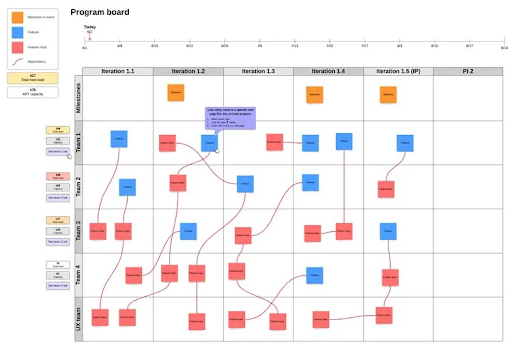
It must be understood that the SAFe® uses a method known as Value Streams. These value streams define the sequence of steps that a company utilizes to execute solutions that give a constant outflow of value to the customers.
A SAFe® portfolio includes one or more such value streams, all of which are allocated to supporting and building the set of valid solutions, which includes the systems, services, and products supplied to the Customer, either external or internal to the Enterprise.
How are SAFe®, Scrum, and Agile Similar?
Scrum, like Kanban and XP, is a kind of Agile. Hence, all Agile kinds are unique in that they will work in a very short breakdown of work, and they remain in very close contact with the customers or users. Hence, the real correlation is between SAFe® and Scrum. Getting to know the SAFe Agile and Agile difference is crucial for project management, mainly while choosing the correct framework for ascending projects across the teams.
SAFe® and Scrum/Agile are unique in that they all utilize roles provided in the Scrum Guide, which include Teams, Scrum Master, and Product Owner. The same rules are put into using retrospectives, sprint reviews, and sprints.
Advantages
A few of the advantages of Agile are:
- Customer satisfaction- The regular involvement of the customers makes sure that they will obtain what they need
- The capability to quickly rotate away from suboptimal solutions to the issues
- Reduced threat due to temporary timeboxes and quality combined into the team
- Permits for constant improvement due to continuous retrospectives
SAFe offers all these advantages, while also allowing for the inspection of work in phases of value streams, along with consideration of the portfolio in relation to the enterprise’s strategy.
Examine the popular Agile Category Courses
| SAFe RTE Certification | ICP-ACC Certification | SAFe POPM Certification |
| PSM Certification | SAFe SPC Certification | SAFe Scrum Master Certification |
| CSN Certification | Leading SAFe Certification | CSPO Certification |
Agile or SAFe Agile: Which one is Better?
The everlasting question: Which kind of methodology rules at the top when we compare SAFe Agile vs Agile? The answer to this is, as with several things in this complex area of project management, has been dependent on context. Agile, along with its collaborative ethos and adaptability, shines in smaller, light projects or teams with fast-changing needs. When concerning to managing the difficulties of large organizations, SAFe Agile takes up the centre stage. It gives a well-organized structure that guarantees agreement among various teams.
Whereas Agile may be the go-to choice for projects or start-ups with a necessity for faster iterations, SAFe Agile will become a hero in some kinds of scenarios where synchronized efforts, structure, and scalability are important. The project manager keeps the key to bringing the “good” choice, as they are required to assess the project’s structure,l objectives, and the size of the organization.
Conclusion
Agile has gradually evolved into the framework that enables business agility, permitting organizations stay adaptable in how they execute work. Clearly assigned responsibilities, incremental work units, and consistent timelines all contribute to the focus on the delivery of the product while reducing potential risks. Comparing SAFe Agile with Agile is important in project management because it helps decide which method fits best based on a project’s scale and scope.
Nevertheless, Agile is primarily designed for smaller teams, but when initiatives grow to an enterprise level, the scaling approach becomes necessary to help teams collaborate while keeping the larger organizational strategy in focus. The Scaled Agile Framework has been one such approach that extends core Agile principles by introducing additional roles and structured events to support implementation across different levels of an organization.
Keep advancing in your PMP journey — explore our other in-depth guides
- 2026 PMP Exam Changes: The “Practicum” Revolution & Why 4 Hours Changes Everything
- The 2026 PMP Exam Shift: How to Master the “Business Environment” Surge (8% to 26%)
- The 5 Scrum Events Explained: Purpose, Attendees, and Effective Execution
- Why PMP Aspirants Fail? – And How to Avoid Them
- Why You Should Track Your Errors — and How to Do It Right
Your first project is calling—will you answer? Join the ShriLearning Community Connect with fellow PMP aspirants and expert instructors. Crete your study plan for free from ShriLearning study-plan-generator.
FAQs
More for you
6 Phases to Run a Successful AI Project
saketpratapsinghdm2026-10-25T15:57:35+05:30October 25th, 2026|
How to Transition From Project Manager to PMO Leader
saketpratapsinghdm2026-10-25T14:09:58+05:30October 25th, 2026|

Sustainable AI Starts with Trustworthy AI: A 2026 Guide for Project Managers
saketpratapsinghdm2026-10-24T17:34:12+05:30October 24th, 2026|

Leading Teams Through Change: How Project Managers Can Drive Successful Transformation in 2026
saketpratapsinghdm2026-10-24T16:59:20+05:30October 24th, 2026|
How to Use AI in Project Management: 10 Practical Workflows
saketpratapsinghdm2026-10-24T15:55:17+05:30October 24th, 2026|
Benefits of Agile Project Management for Small and Medium-Sized Businesses
saketpratapsinghdm2026-09-28T10:12:30+05:30September 28th, 2026|

Work Breakdown Structure (WBS): The Complete PMP Guide, With a Worked Example
saketpratapsinghdm2026-09-21T16:48:15+05:30September 21st, 2026|
Stakeholder Management and RACI: The Complete PMP Guide (With a Worked Example)
saketpratapsinghdm2026-09-21T15:07:42+05:30September 21st, 2026|