PMP Exam 2026 Update: What Every Indian Aspirant Needs to Know Before 9 July
PMP Exam 2026 Update: What Every Indian Aspirant Needs to Know Before 9 July
If you are currently preparing for your PMP — or seriously thinking about starting — there is one date you need to write down right now: 9 July 2026.
That is when the Project Management Professional exam is getting its most significant update in years. The changes are not cosmetic tweaks to a question bank. They reflect a fundamental shift in what PMI believes a credible project leader needs to know in 2026 — and that has real implications for how you should prepare, and how urgently you need to act.
Table of Contents
- Why PMI Is Updating the PMP Exam
- The Five Key Changes — Explained
- What Changes Mean for Indian Aspirants Specifically
- Current Exam vs. Updated Exam: Which Should You Take?
- How to Prepare — Whichever Version You Are Taking
1. Why PMI Is Updating the PMP Exam
PMI periodically conducts what it calls a Role Delineation Study — a global survey of practising project professionals across industries — to understand how the role is actually evolving on the ground. The findings from the most recent study are clear: the job of a project manager in 2026 looks meaningfully different from what it did five years ago.
Project managers today are expected to connect their projects to broader business outcomes, navigate AI tools as part of their daily environment, factor sustainability into planning decisions, and manage stakeholder relationships that extend far beyond their immediate team. The exam has to reflect that reality — otherwise, the credential loses its credibility as a measure of real-world competence.
This is not PMI making the exam harder for the sake of it. It is PMI ensuring that a PMP certificate in 2026 actually signals what employers need it to signal.
2. The Five Key Changes — Explained
Change 1: The Business Environment Domain Gets a Major Upgrade
This is the single biggest structural change in the updated exam. The Business Environment domain — which covers how projects sit within the broader organisational and market context — is being dramatically reweighted.
| Domain | Current Exam Weight | Updated Exam Weight | What This Means |
| Business Environment | 8% | 26% | Now covers nearly a quarter of the exam |
| People | 42% | ~38% | Slight reduction, but scope widens |
| Process | 50% | ~36% | Remains large but no longer dominant |
In practical terms, the updated exam will test your ability to think like a business leader — not just a delivery manager. Expect questions on governance structures, compliance obligations, organisational change management, strategic risk, and how external market forces affect project decisions.
For Indian aspirants working in MNCs or large IT services firms, this shift actually plays in your favour. These environments demand exactly this kind of cross-functional, business-aware thinking — and you likely have real experience to draw on.
Change 2: Leadership Now Means More Than Managing Your Team
The People domain is not shrinking in importance — it is expanding in scope. The current exam focuses heavily on internal team dynamics: conflict resolution, team motivation, mentoring, and emotional intelligence within your project team.
The updated exam keeps all of that and adds an outer ring: stakeholder engagement beyond your immediate team, strategic communication planning, managing customer expectations (both internal and external), and supporting governance and reporting processes. In short, you are not just expected to lead a team — you are expected to lead across an organisation.
What This Means in Practice
Study stakeholder engagement strategies, not just team management techniques. Understand how project communications connect to governance and executive reporting. Be ready for scenario questions where the ‘team’ problem is actually a stakeholder alignment problem in disguise.
Change 3: AI and Sustainability Are Now Part of the Project Landscape
These two topics have generated the most questions from aspirants — and a lot of unnecessary anxiety. Here is the straightforward reality: the updated PMP exam does not expect you to be an AI expert or a sustainability specialist.
AI appears in the exam the same way a project dashboard or a scheduling tool does — as part of the environment you are navigating. You might be asked how you would evaluate an AI-generated risk report, or how you would manage a team that is experimenting with AI-assisted planning tools. The exam tests judgment, not technical expertise.
Sustainability is treated the same way — woven into planning, quality, risk, and compliance decisions rather than tested as a separate domain. You might encounter a question where a project’s scope needs to account for environmental regulations, or where a vendor’s sustainability practices are a procurement risk. These are judgement calls, not textbook recall.
The practical preparation advice: stay aware of how AI tools are being used in project environments (you are probably already encountering them), and understand that sustainability is becoming a standard project constraint — not unlike budget or timeline.
Change 4: New Question Types That Reflect Real Project Work
The current PMP exam already uses a mix of formats beyond standard multiple choice — drag-and-drop, matching, and hotspot questions are part of the existing exam. The updated exam goes further.
Two new formats are being introduced:
- Case/scenario-based questions:
Longer, richer project scenarios where you read a more detailed situation and answer several related questions. This is closer to how real project decisions actually unfold — with context, constraints, and competing priorities all present at once.
- Graphic and dashboard-based questions:
You may be shown a project dashboard, a Gantt chart, an earned value report, or a risk matrix and asked to interpret what it tells you and what action it implies. This tests practical literacy with the tools and artifacts PMs actually use.
Preparation Implication
If you are preparing for the updated exam, do not rely solely on question banks built around the current format. Practise interpreting project artifacts, working through longer scenarios, and making decisions with ambiguous information — not just recalling definitions.
Change 5: More Pathways to Eligibility
The updated exam expands which educational qualifications count toward PMP eligibility. Associate-level degrees, advanced vocational qualifications, and recognised technical programmes are now included — alongside the existing four-year degree and high school diploma pathways.
For eligible candidates through these expanded pathways, four years of project leadership experience can meet the requirement.
This matters for Indian aspirants from polytechnic, diploma, or vocational backgrounds who previously fell into the longer 60-month experience track. If this applies to you, check the updated eligibility requirements on PMI.org — you may now qualify under a faster pathway.
3. What These Changes Mean for Indian Aspirants Specifically
| Change | Indian Market Relevance | Your Advantage |
| Business Environment domain (26%) | MNCs in India increasingly expect PMs to think in business terms, not just delivery terms | IT services PMs already navigate governance, compliance, and client business context daily |
| Broader leadership scope | Stakeholder management across cultures and geographies is a daily reality in Indian IT delivery | Cross-functional, multi-stakeholder experience is a genuine differentiator |
| AI in context | Indian IT sector is among the fastest adopters of AI-assisted tools globally | Familiarity with AI tools in Jira, ClickUp, or Salesforce is directly relevant |
| Scenario-based questions | Requires stronger analytical thinking — less rote memorisation | A shift that rewards experience over pure exam coaching |
| Expanded eligibility | Diploma and polytechnic graduates may qualify sooner | Check updated criteria — your pathway may have shortened |
4. Current Exam vs. Updated Exam: Which Should You Take?
This is the question ShriLearning gets most often right now. Here is a clear, honest framework:
| Your Situation | Recommended Action |
| Already preparing, on track to sit before 8 July 2026 | Stay the course. Do not disrupt your preparation. The current exam is valid, rigorous, and recognised identically by employers. |
| Just starting preparation today (April 2026) | Prepare for the updated exam using resources launching 14 April. Your preparation timeline will naturally take you past 9 July. |
| Somewhere in the middle — partially prepared, not yet booked | Assess honestly: can you be exam-ready before 8 July? If yes, book now — slots fill fast near the deadline. If not, switch to updated resources. |
| Have not started, exploring PMP for the first time | Prepare for the updated exam. It is more aligned with where the profession is heading, and the resources are already available. |
Key Dates to Remember14 April 2026 — Updated prep resources available from PMI. 8 July 2026 — Last day to sit the current PMP exam. 9 July 2026 — Updated PMP exam launches. Book early — Pearson VUE slots in Indian cities (Bengaluru, Hyderabad, Delhi NCR, Pune) get scarce in June as the deadline approaches. |
5. How to Prepare — Whichever Version You Are Taking
If You Are Taking the Current Exam (before 8 July 2026)
- Your existing PMBOK 7th edition study materials and Agile Practice Guide remain fully relevant.
- Focus on the 50/50 split: approximately half the current exam is predictive/waterfall-based, half is Agile and hybrid.
- Prioritise scenario-based practice over definition memorisation — the current exam already tests situational judgment.
- Book your Pearson VUE slot now. Do not wait. Indian metro slots are filling up for May and June.
If You Are Taking the Updated Exam (from 9 July 2026)
- Use the updated prep resources launching 14 April 2026 from PMI — these are built specifically for the new exam.
- Spend additional preparation time on the Business Environment domain — governance, compliance, strategic risk, and change management are now 26% of your exam.
- Practise reading and interpreting project artifacts: Gantt charts, earned value dashboards, risk matrices. The new graphic-based questions require visual literacy, not just textbook knowledge.
- Work through extended project scenarios — get comfortable making decisions with incomplete information and competing priorities.
- Do not neglect AI and sustainability context — read industry articles on how AI tools are used in project management and understand sustainability as a planning constraint.
The Bottom Line
The PMP exam is evolving because project leadership itself is evolving. The 2026 update is not a disruption to fear — it is a signal that the credential is staying relevant, which is exactly what makes it worth earning.
Whether you are three months into your preparation or just starting to explore the idea, the path forward is clear: understand which version applies to your timeline, prepare accordingly, and do not let the change become an excuse to delay a decision that has clear, proven career value.
India’s project management job market is growing faster than the supply of credentialed professionals. The PMP — in any version — remains the single most recognised signal of readiness for senior PM roles in this market.
Keep advancing in your PMP journey — explore our other in-depth guides
- 2026 PMP Exam Changes: The “Practicum” Revolution & Why 4 Hours Changes Everything
- The 2026 PMP Exam Shift: How to Master the “Business Environment” Surge (8% to 26%)
- The 5 Scrum Events Explained: Purpose, Attendees, and Effective Execution
- Why PMP Aspirants Fail? – And How to Avoid Them
- Why You Should Track Your Errors — and How to Do It Right
Your first project is calling—will you answer? Join the ShriLearning Community Connect with fellow PMP aspirants and expert instructors. Crete your study plan for free from ShriLearning study-plan-generator.
FAQs
More for you
How to Use AI in Project Management: 10 Practical Workflows
saketpratapsinghdm2026-10-24T15:48:41+05:30October 24th, 2026|
Benefits of Agile Project Management for Small and Medium-Sized Businesses
saketpratapsinghdm2026-09-28T10:12:30+05:30September 28th, 2026|

Work Breakdown Structure (WBS): The Complete PMP Guide, With a Worked Example
saketpratapsinghdm2026-09-21T16:48:15+05:30September 21st, 2026|
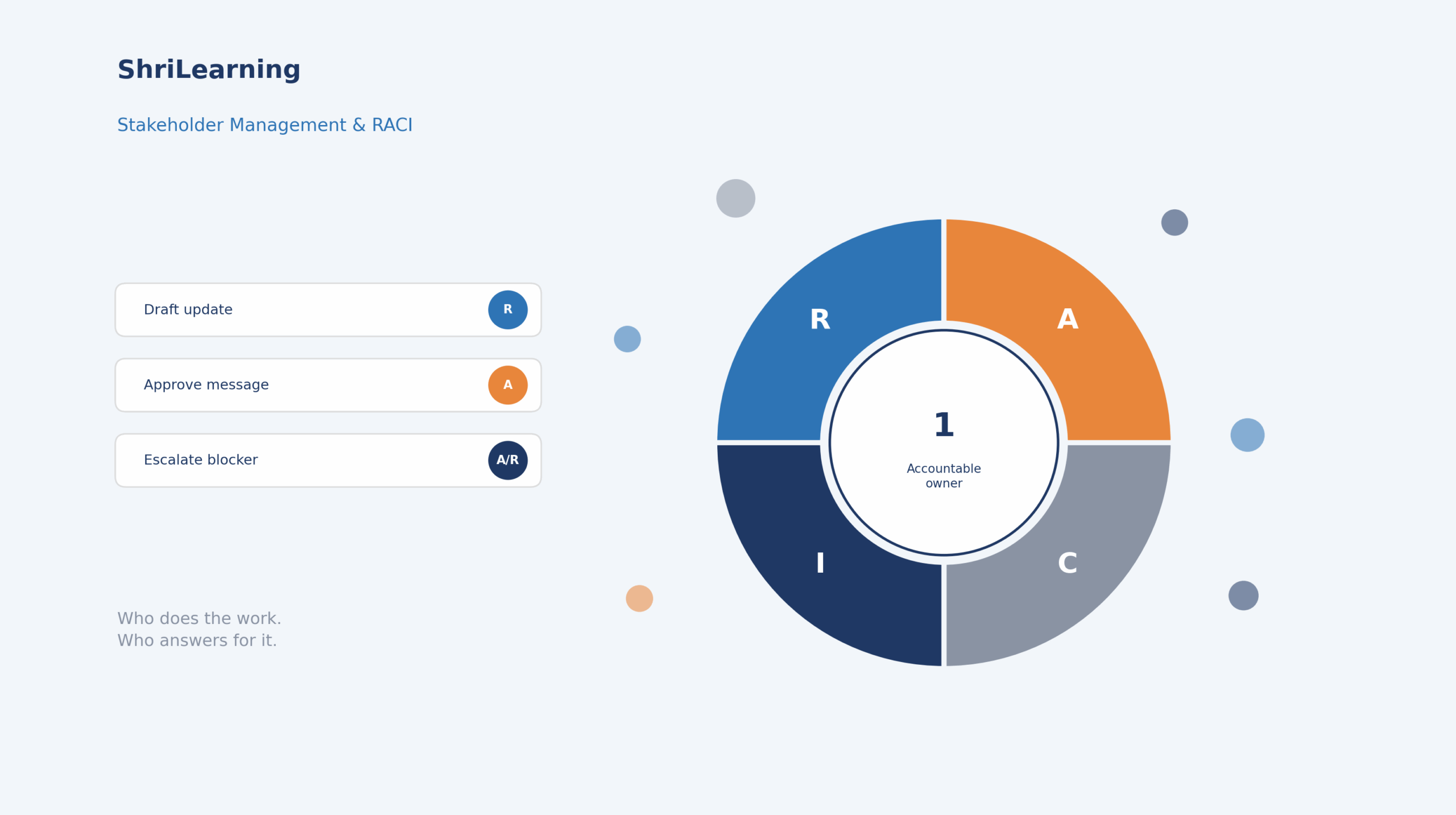
Stakeholder Management and RACI: The Complete PMP Guide (With a Worked Example)
saketpratapsinghdm2026-09-21T15:07:42+05:30September 21st, 2026|
How to Write a Problem Statement (With a PMP-Ready Template and Examples)
saketpratapsinghdm2026-09-21T14:42:27+05:30September 21st, 2026|

Earned Value Management: How to Actually Read CPI and SPI (Not Just Calculate Them)
saketpratapsinghdm2026-09-17T15:32:44+05:30September 17th, 2026|

Agile Practice Guide – Second Edition: What Changed, and What It Means for Your PMI-ACP Prep
saketpratapsinghdm2026-09-17T14:45:53+05:30September 17th, 2026|

Why the PMP People Domain Dropped to 33% (And How to Master It in 2026)
saketpratapsinghdm2026-08-27T21:18:31+05:30August 27th, 2026|