10 Best Project Management Tools & Software (2026)
10 Best Project Management Tools & Software (2026)
Every PMP aspirant hits a wall at some point — not because they don’t understand the concepts, but because they’ve never connected the theory to the actual tools used in the real world. The 2026 PMP exam doesn’t just test what you know about project management. It tests whether you can think like a practitioner. And practitioners use tools.
This guide breaks down the most important project management tools you need to know — both for passing the PMP exam and for thriving in your career afterward.
Table of Contents
- Why Project Management Tools Matter for the PMP Exam
- The Two Categories of PM Tools You Must Understand
- Planning & Scheduling Tools
- Agile & Collaboration Tools
- Risk & Cost Management Tools
- AI Tools Entering the PM World in 2026
- Predictive vs. Agile Tools — Side-by-Side Comparison
- Which Tools Does the PMP Exam Actually Test?
1. Why Project Management Tools Matter for the PMP Exam
Short answer: Because PMI’s Examination Content Outline (ECO) tests your ability to apply tools and techniques in realistic scenarios — not just recall their names.
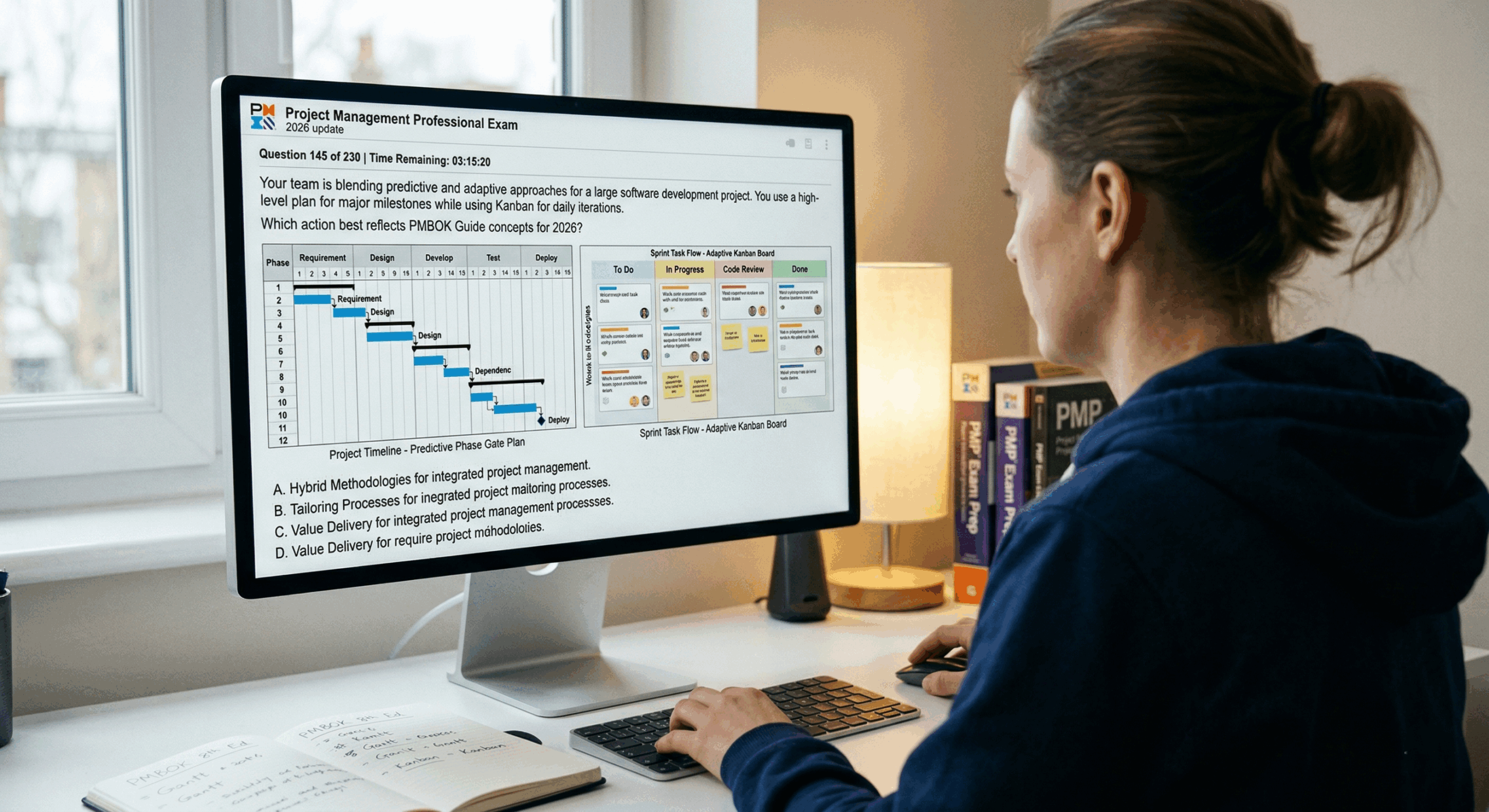
The 2026 PMP exam is scenario-based. That means a question won’t ask “What is a Gantt chart?” It will give you a situation — a delayed schedule, a budget overrun, a stakeholder conflict — and ask you what tool or technique a competent project manager would use to address it.
If you’ve never worked with these tools conceptually, those scenario questions will trip you up fast. Roughly 50% of PMP exam questions are rooted in Agile and hybrid environments, so knowing which tool fits which context is just as important as knowing the PMBOK® processes.
2. The Two Categories of PM Tools You Must Understand
Before diving into specific tools, understand that the PMP exam — and real project management — divides tools into two worlds:
Predictive (Waterfall) Tools — Used when scope, time, and cost are well-defined upfront. Think large infrastructure projects, government contracts, or construction.
Agile & Hybrid Tools — Used when requirements evolve, change is frequent, and delivering value iteratively matters more than following a fixed plan. Think software development, product launches, and digital transformation.
Knowing when to use which category is what separates a PMP-certified project manager from someone who just memorized definitions.
3. Planning & Scheduling Tools
Gantt Chart
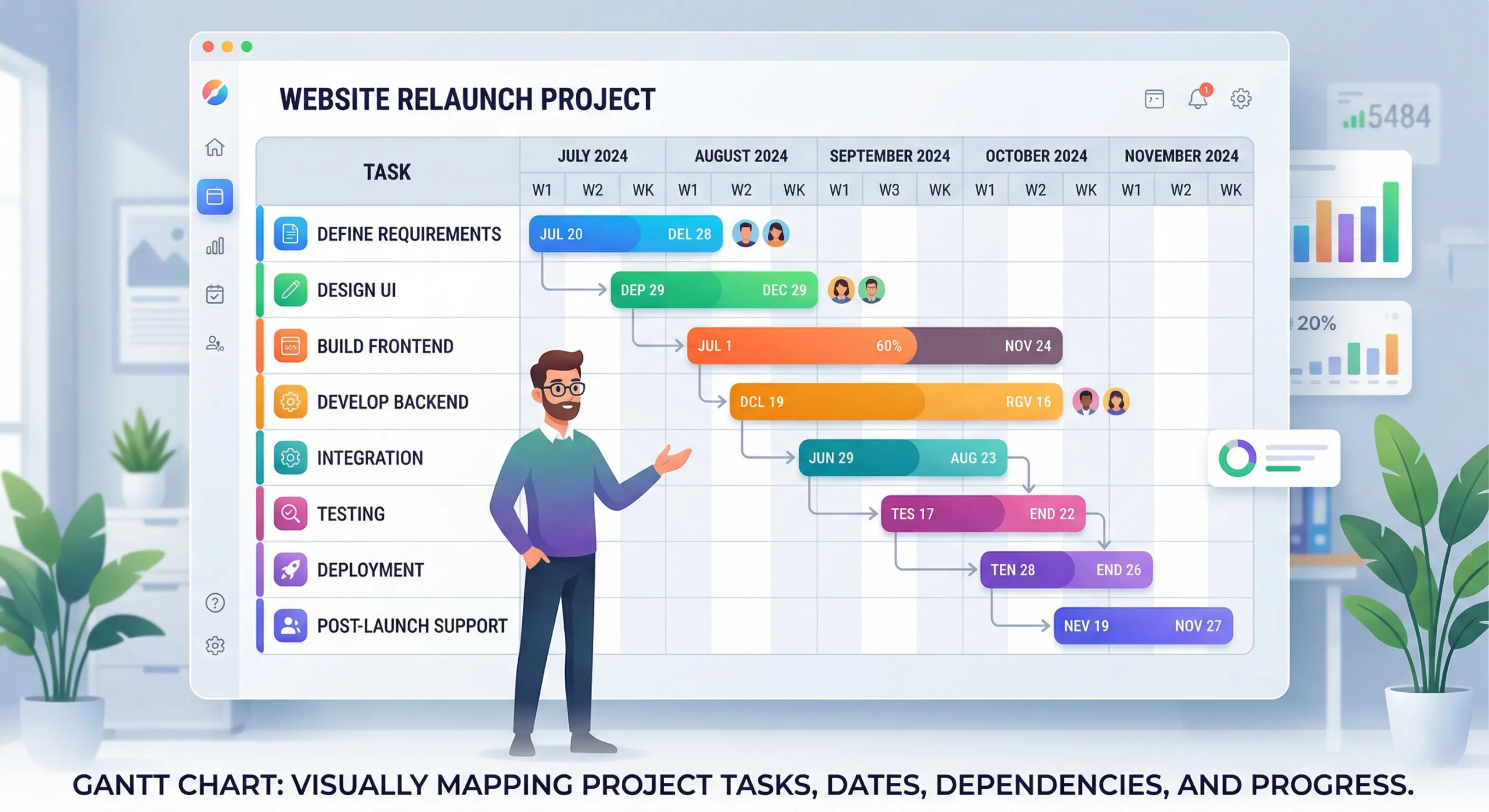
What it is: A bar chart that visually maps project tasks against a timeline, showing start dates, end dates, dependencies, and progress.
Why it matters for PMP: The Gantt chart is the cornerstone of predictive project planning. It is explicitly referenced in the PMBOK® Guide as a schedule presentation tool. On the exam, expect scenarios where you must identify whether a Gantt chart is the appropriate tool — particularly when a stakeholder needs a clear visual of the timeline.
Real-world tools that use it: Microsoft Project, Smartsheet, TeamGantt, and Asana all generate Gantt charts natively.
Exam tip: Gantt charts show what is happening and when, but they don’t always show the critical path clearly. For that, you need a network diagram.
Network Diagram (PDM — Precedence Diagramming Method)
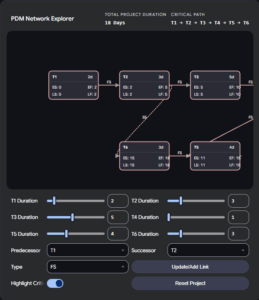
What it is: A visual representation of the logical relationships between project activities. Each activity is a node, and arrows show dependencies (Finish-to-Start, Start-to-Start, etc.)
Why it matters for PMP: Network diagrams are how you calculate the critical path — one of the most heavily tested topics on the exam. Understanding the four types of dependencies (FS, SS, FF, SF) in a network diagram is non-negotiable.
Exam tip: When a question involves schedule compression or identifying which tasks have zero float, you are almost certainly being asked to apply network diagram logic.
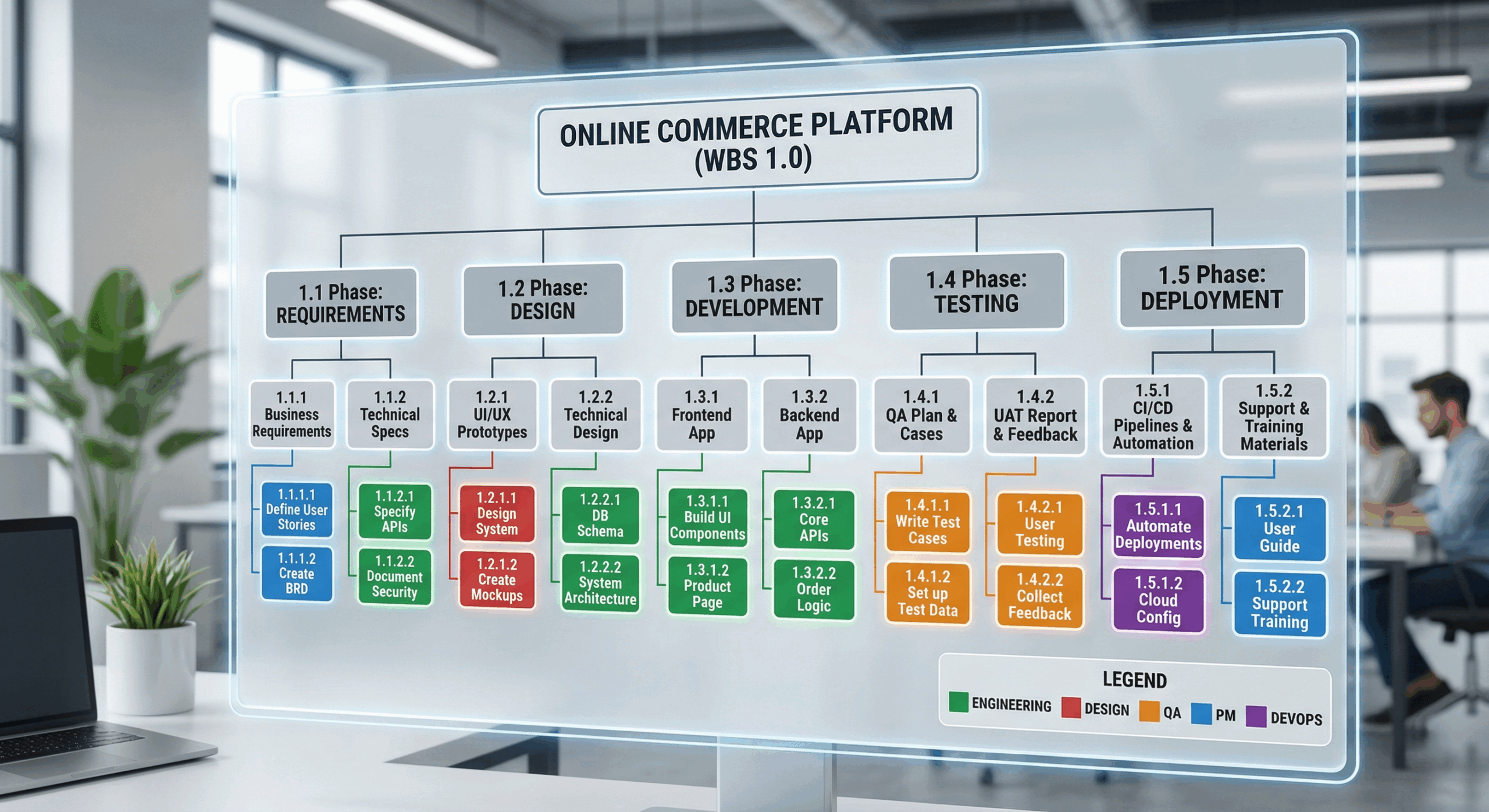
Work Breakdown Structure (WBS)
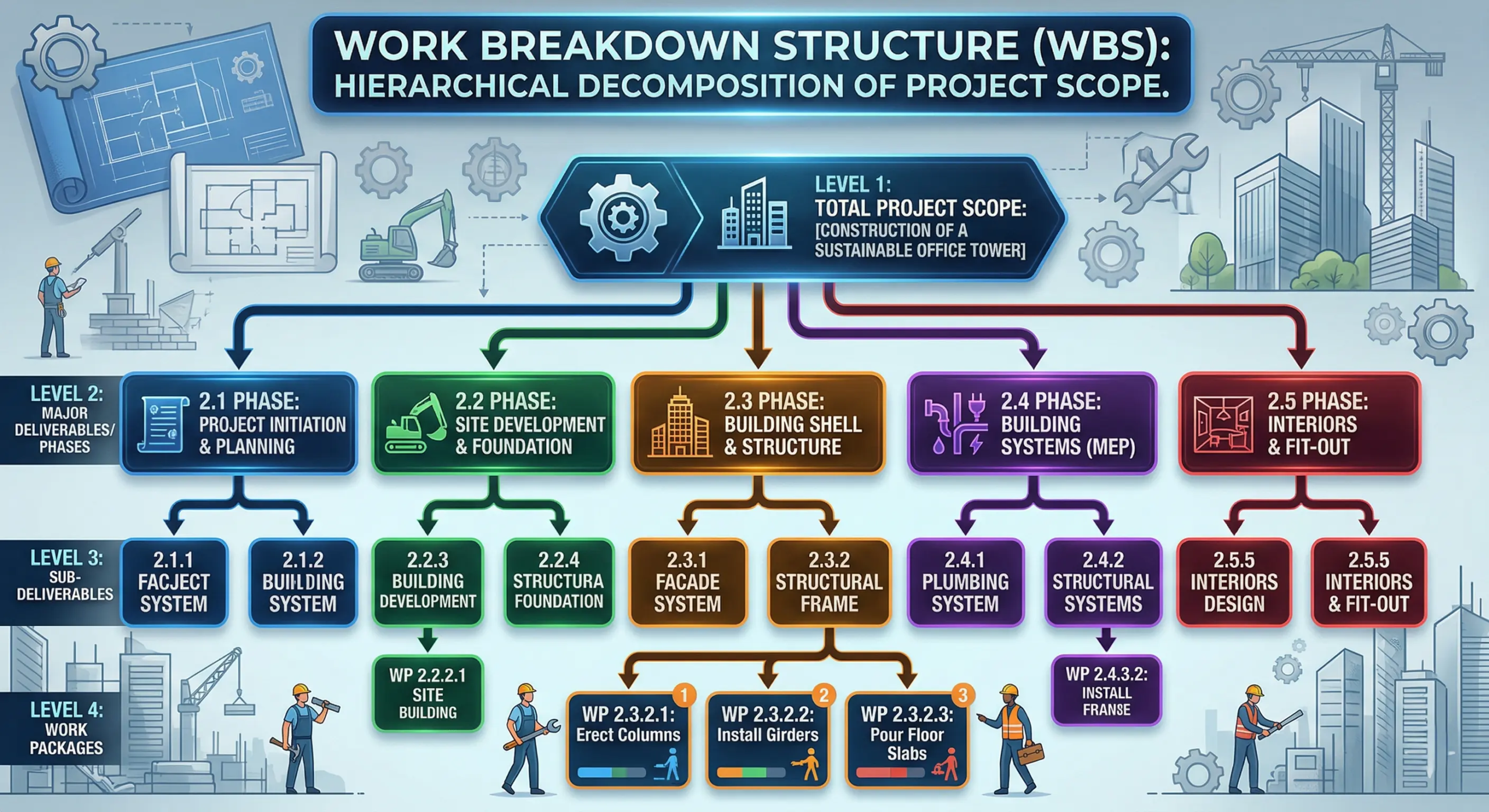
What it is: A hierarchical decomposition of the total project scope into smaller, manageable components called work packages.
Why it matters for PMP: The WBS is not just a planning tool — it’s the foundation of everything else. Schedule activities are derived from the WBS. Cost estimates are built from it. Resource assignments flow from it. The exam frequently tests whether you know that the WBS defines scope, not sequence.
4. Agile & Collaboration Tools
Kanban Board
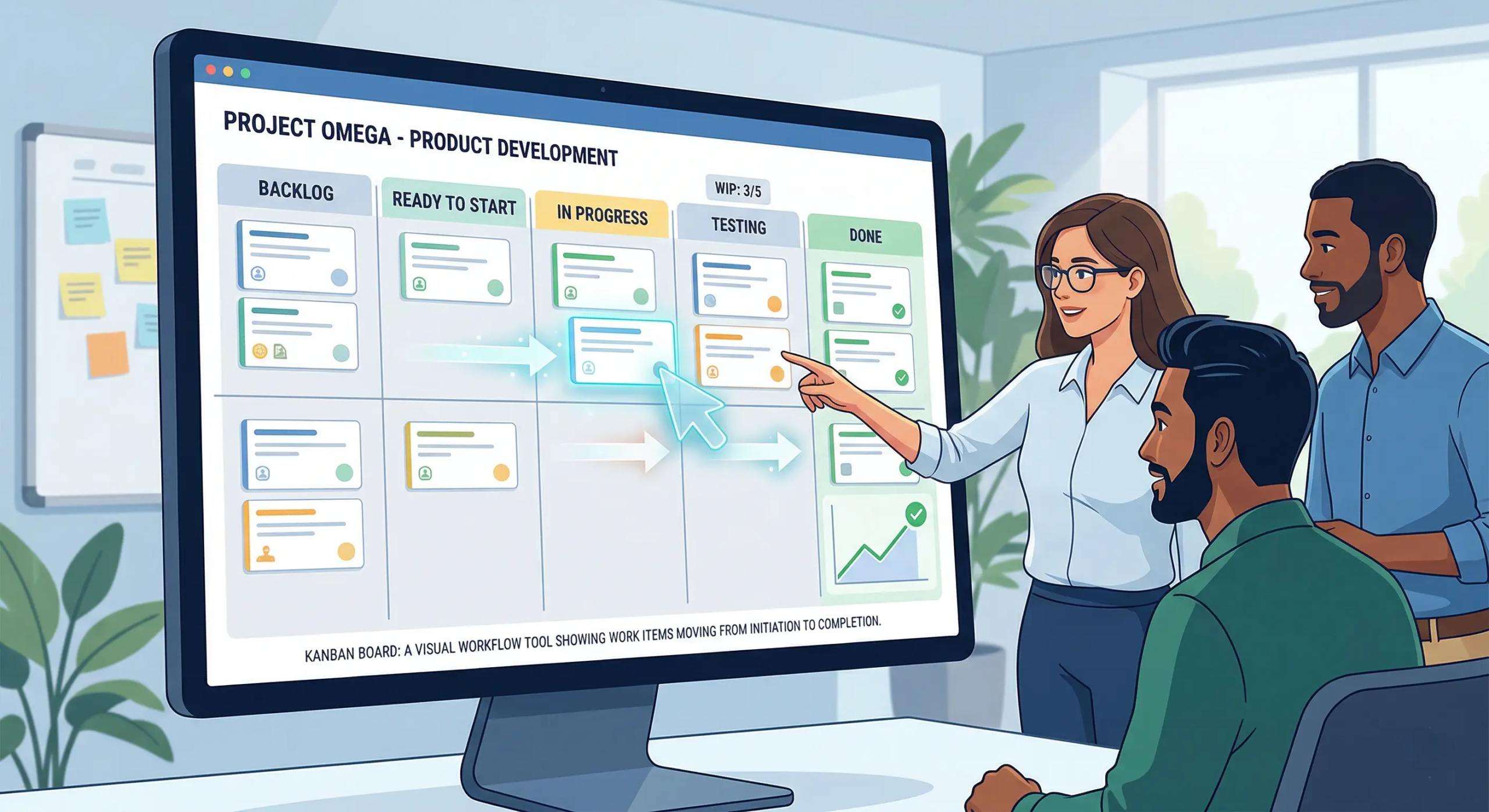
What it is: A visual workflow tool that displays work items as cards moving across columns — typically “To Do,” “In Progress,” and “Done.”
Why it matters for PMP: With 50% of the 2026 PMP exam focused on agile and hybrid approaches, Kanban is fair game. The key concept the exam tests is WIP (Work in Progress) limits — the principle that limiting how much work is simultaneously in progress improves flow and reduces bottlenecks.
Real-world tools: Jira, Trello, Azure DevOps, and Monday.com all feature Kanban views.
Exam tip: Kanban is a flow-based system. Unlike Scrum, it has no fixed-length sprints. Questions that describe a team pulling work continuously without time-boxed iterations are describing Kanban.
Scrum Board / Sprint Backlog
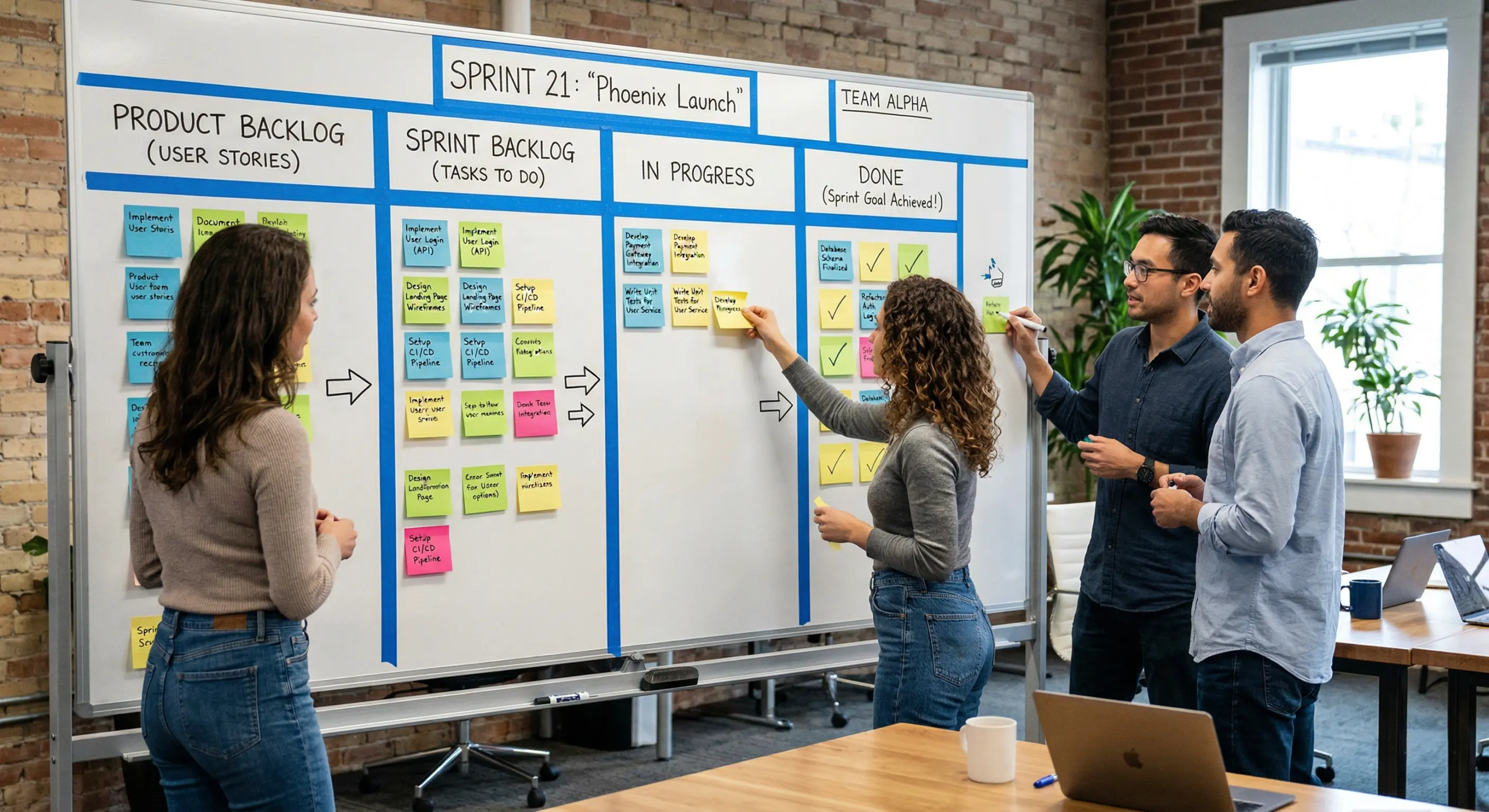
What it is: A task board used within Scrum to track the work committed to a sprint. Items move from the Product Backlog → Sprint Backlog → In Progress → Done.
Why it matters for PMP: Scrum is the most widely tested Agile framework on the PMP exam. You need to know the five Scrum Events (Sprint, Sprint Planning, Daily Scrum, Sprint Review, Sprint Retrospective), three roles (Product Owner, Scrum Master, Development Team), and three artifacts (Product Backlog, Sprint Backlog, Increment).
Exam tip: The Scrum Master in exam questions almost always “facilitates and removes impediments.” If a scenario shows a Scrum Master making decisions for the team or managing a timeline, that is a wrong answer.
Burndown Chart
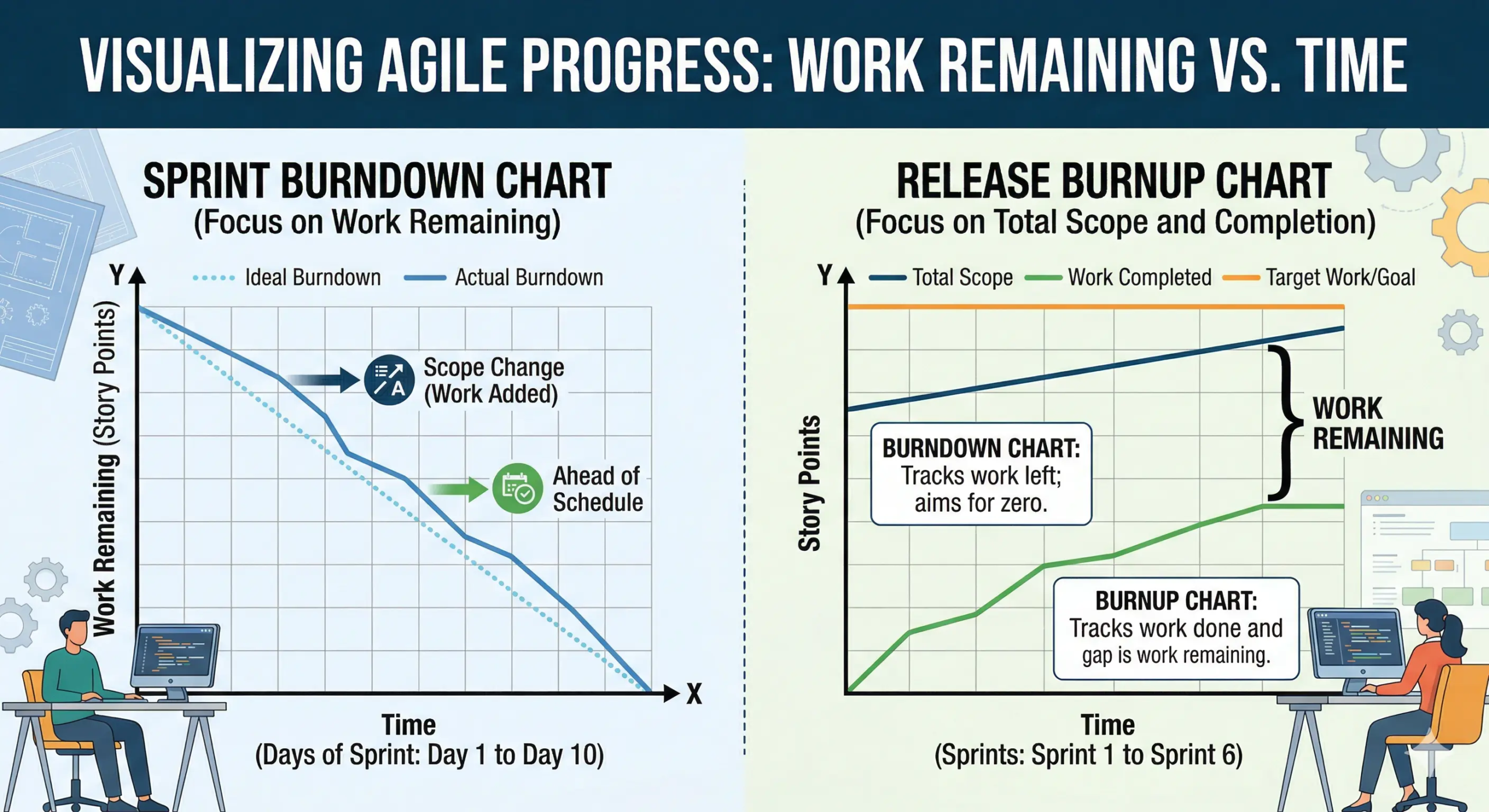
What it is: A graphical representation of work remaining versus time in an Agile sprint or release.
Why it matters for PMP: The burndown chart is an Agile progress monitoring tool. The exam may show you a burndown chart and ask you to interpret it — is the team ahead of schedule, behind, or on track? A line above the ideal trend means the team is behind. A line below means they’re ahead.
5. Risk & Cost Management Tools {#risk-cost-tools}
Risk Register
What it is: A documented record of all identified project risks, including their probability, impact, response strategies, and owners.
Why it matters for PMP: The risk register is one of the most frequently referenced project documents in the PMBOK® Guide. It is used across multiple processes — from risk identification all the way through risk monitoring and control.
Exam tip: The risk register is a living document. It gets updated throughout the project. Exam scenarios that ask what to do when a new risk is identified — the answer almost always involves updating the risk register.
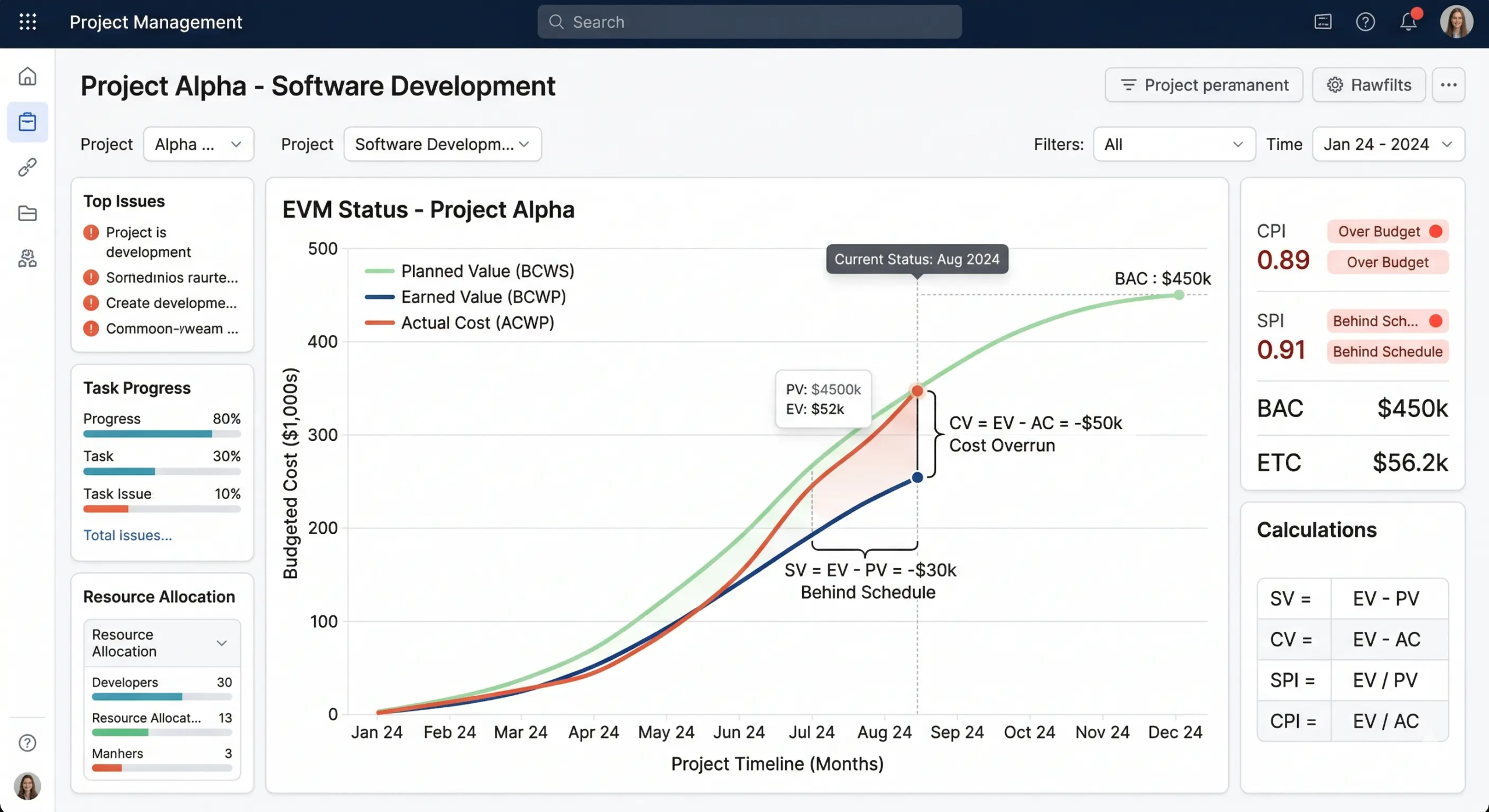
Earned Value Management (EVM) Tools
What it is: A quantitative performance measurement system that integrates scope, schedule, and cost to assess project health.
Key formulas you must know:
| Formula | What It Tells You |
| EV = BAC × % Complete | Earned Value — work actually accomplished in dollar terms |
| CV = EV − AC | Cost Variance — negative means over budget |
| SV = EV − PV | Schedule Variance — negative means behind schedule |
| CPI = EV ÷ AC | Cost Performance Index — below 1.0 means over budget |
| SPI = EV ÷ PV | Schedule Performance Index — below 1.0 means behind schedule |
| EAC = BAC ÷ CPI | Estimate at Completion — projected final cost |
Why it matters for PMP: EVM is one of the most calculation-heavy sections of the PMP exam. A minimum of 5–8 questions in any sitting will require you to either calculate or interpret EVM metrics.
Probability and Impact Matrix
What it is: A grid that plots risks based on their likelihood of occurring (probability) and the severity of their effect (impact), helping prioritise which risks need the most attention.
Why it matters for PMP: This is the primary qualitative risk analysis tool. When an exam scenario describes a project team reviewing and ranking risks, they are using a Probability and Impact Matrix — even if the question doesn’t name it directly.
6. AI Tools Entering the PM World in 2026
The 2026 PMP exam content reflects the reality that AI is now part of the project manager’s toolkit. While the exam won’t ask you to operate a specific AI tool, it increasingly tests your ability to think about how emerging technology affects project planning, team dynamics, and risk.
Here are the AI-assisted tools top project managers are actively using right now:
- Microsoft Copilot in Project — Generates project summaries, suggests task dependencies, and drafts status reports from raw data.
- Notion AI — Helps teams summarise meeting notes, create action item lists, and maintain project wikis automatically.
- ClickUp AI — Assists in writing task descriptions, identifying blockers, and auto-updating project timelines.
- Jira’s AI Features — Predicts sprint completion rates and flags at-risk tickets based on historical velocity data.
The key exam mindset: AI tools are used to support decision-making, not replace the project manager’s judgment. Questions framed around AI adoption in projects will test whether you understand that human oversight and stakeholder communication remain the PM’s primary responsibility.
7. Predictive vs. Agile Tools — Side-by-Side Comparison
| Tool / Technique | Best For | Approach | PMP Exam Relevance |
| Gantt Chart | Fixed-timeline projects | Predictive | High — schedule baseline |
| Network Diagram (PDM) | Critical path analysis | Predictive | Very High — frequently calculated |
| WBS | Scope decomposition | Predictive & Hybrid | Very High — scope foundation |
| Kanban Board | Continuous flow work | Agile | High — WIP limits tested |
| Scrum Board | Sprint-based delivery | Agile | Very High — Scrum is core |
| Burndown Chart | Sprint progress tracking | Agile | High — interpretation questions |
| Risk Register | Risk tracking | All approaches | Very High — used throughout |
| EVM (CPI, SPI, EAC) | Cost & schedule performance | Predictive & Hybrid | Very High — calculation questions |
| Probability-Impact Matrix | Risk prioritisation | All approaches | High — qualitative risk analysis |
| AI-Assisted PM Tools | Automation & forecasting | Hybrid & Agile | Emerging — awareness tested |
8. Which Tools Does the PMP Exam Actually Test? {#exam-tools}
Based on PMI’s official Examination Content Outline (ECO), here are the tool categories directly mapped to exam domains:
Domain 1 — People (33%% of exam): Stakeholder engagement tools, team performance assessments, conflict resolution techniques, the RACI matrix, and virtual collaboration platforms.
Domain 2 — Process (41% of exam): WBS, Gantt charts, network diagrams, risk register, EVM formulas, Kanban boards, Scrum ceremonies, change control tools, and quality management checklists.
Domain 3 — Business Environment (26% of exam): Benefits realisation frameworks, organisational change management tools, and compliance tracking — with increasing reference to AI and sustainability tools in 2026.
The bottom line: You don’t need to be a software expert in any of these tools. What you need is conceptual fluency — knowing what each tool is designed to do, when to use it, and how to interpret its outputs.
Every tool covered in this article is taught not in isolation, but in the context of real exam scenarios. ShriLearning’s instructors walk you through why a network diagram is the right answer in one question and why a risk register update is the right answer in another — using the same scenario-based thinking that PMI uses to write the exam.
The program includes:
- Live instructor-led sessions covering all three ECO domains
- Tool-specific mock questions that mirror the 2026 exam format
- Personalised feedback on why you’re getting questions wrong and how to fix it
- Study materials aligned with the PMBOK® 8th Edition and the Agile Practice Guide
If you’re serious about passing the PMP on your first attempt, the difference between studying alone and studying with the right mentorship is the difference between guessing on tool questions and knowing exactly which tool fits which scenario.
Keep advancing in your PMP journey — explore our other in-depth guides
- 2026 PMP Exam Changes: The “Practicum” Revolution & Why 4 Hours Changes Everything
- The 2026 PMP Exam Shift: How to Master the “Business Environment” Surge (8% to 26%)
- The 5 Scrum Events Explained: Purpose, Attendees, and Effective Execution
- Why PMP Aspirants Fail? – And How to Avoid Them
- Why You Should Track Your Errors — and How to Do It Right
Your first project is calling—will you answer? Join the ShriLearning Community Connect with fellow PMP aspirants and expert instructors. Crete your study plan for free from ShriLearning study-plan-generator.
FAQs
More for you
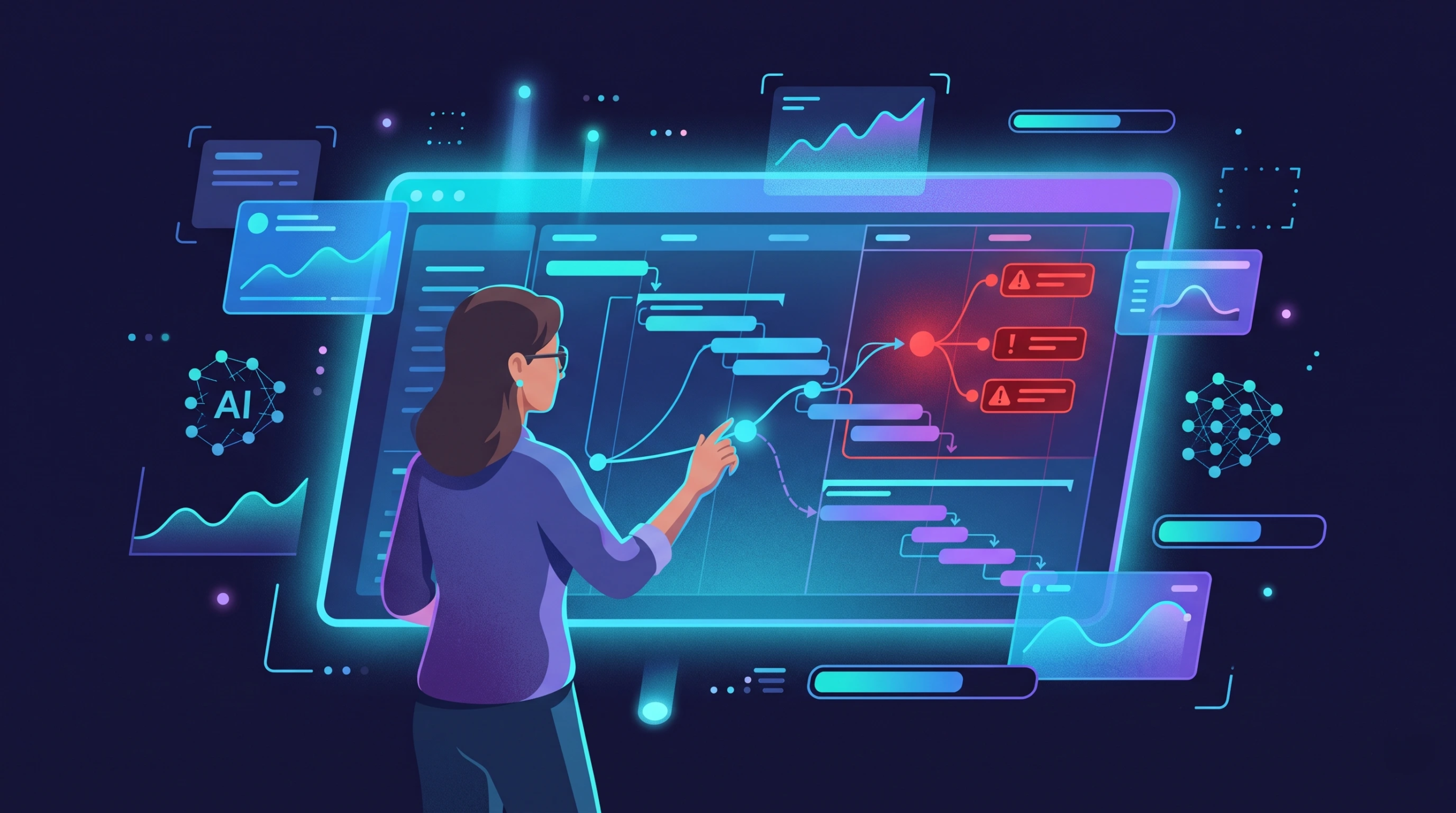
How to Use AI in Project Management: 10 Practical Workflows
saketpratapsinghdm2026-10-24T15:48:41+05:30October 24th, 2026|
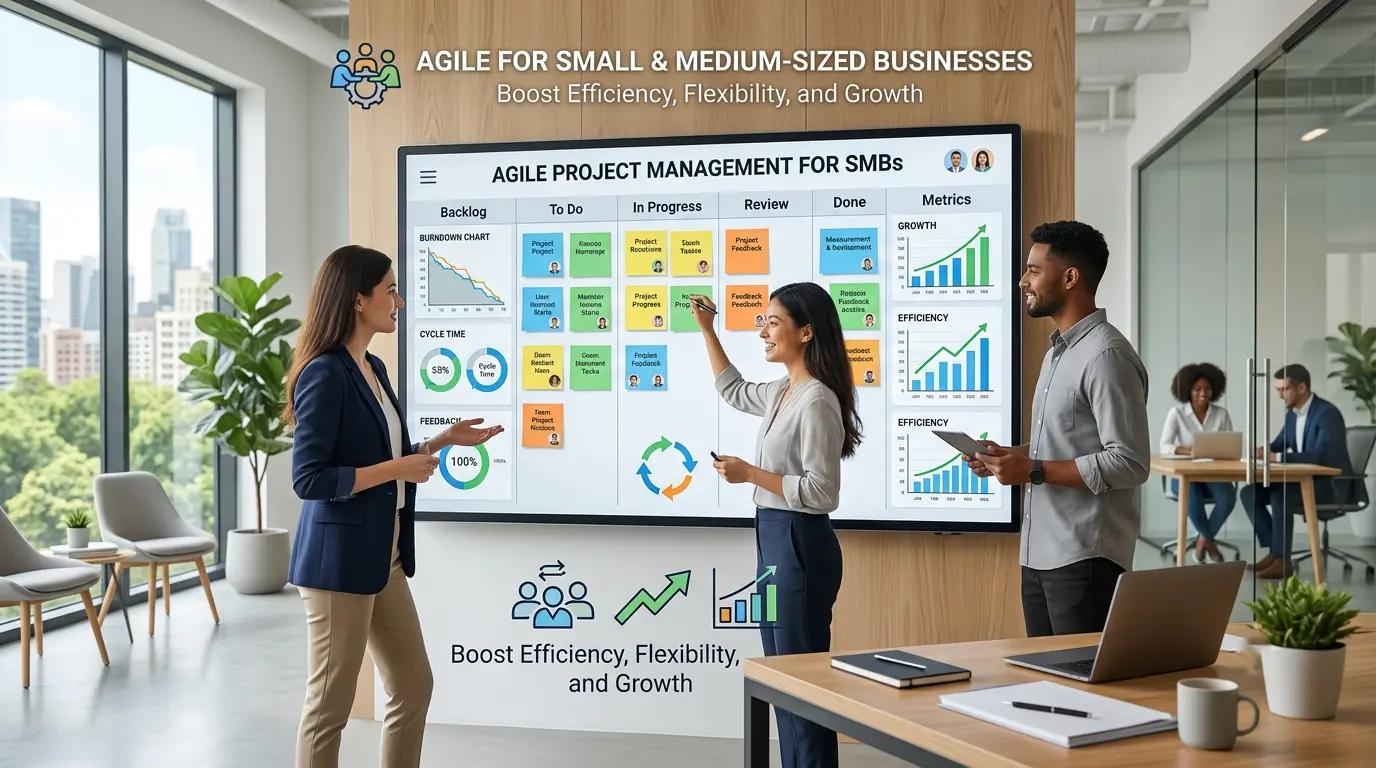
Benefits of Agile Project Management for Small and Medium-Sized Businesses
saketpratapsinghdm2026-09-28T10:12:30+05:30September 28th, 2026|

Work Breakdown Structure (WBS): The Complete PMP Guide, With a Worked Example
saketpratapsinghdm2026-09-21T16:48:15+05:30September 21st, 2026|
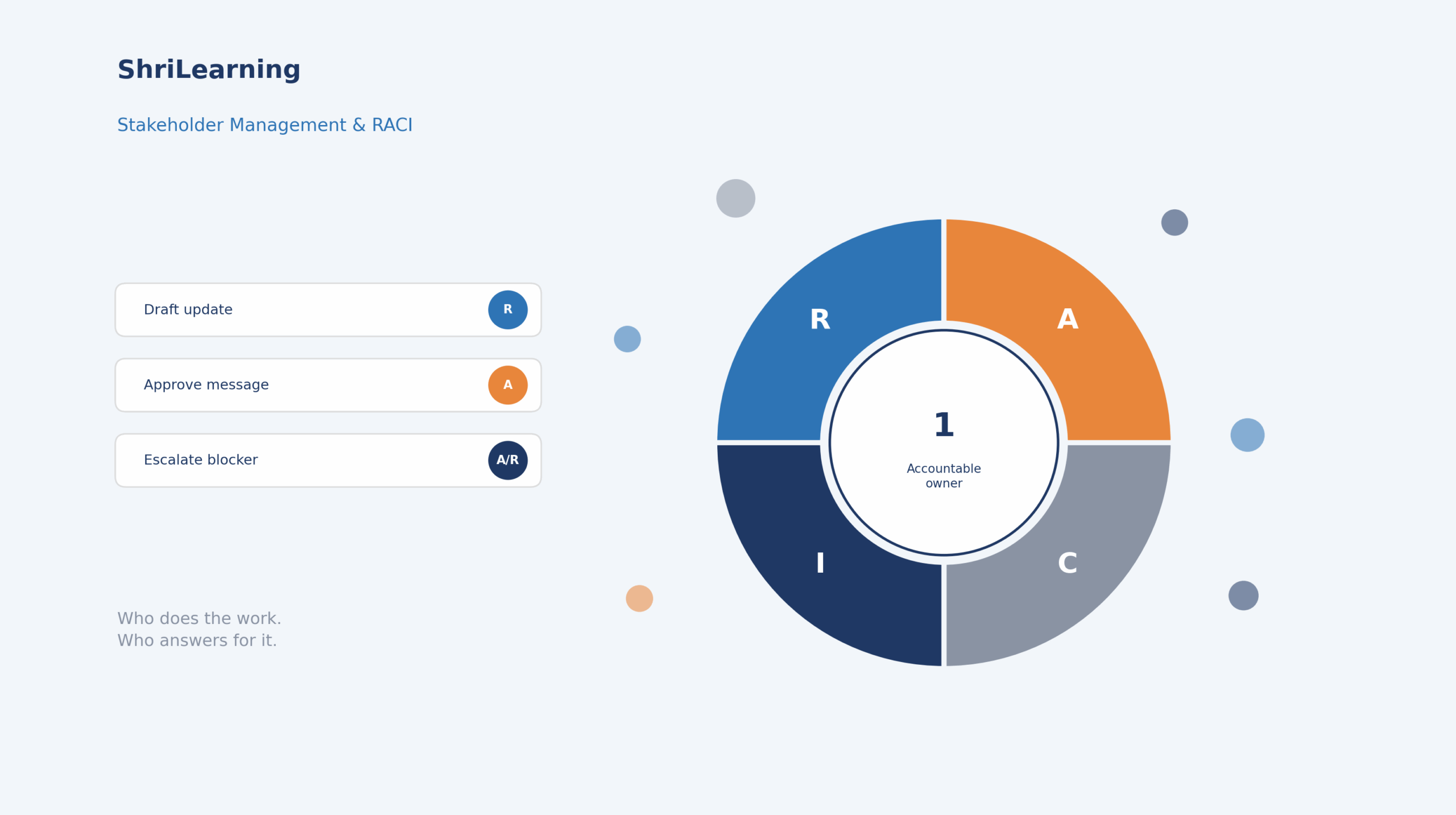
Stakeholder Management and RACI: The Complete PMP Guide (With a Worked Example)
saketpratapsinghdm2026-09-21T15:07:42+05:30September 21st, 2026|
How to Write a Problem Statement (With a PMP-Ready Template and Examples)
saketpratapsinghdm2026-09-21T14:42:27+05:30September 21st, 2026|

Earned Value Management: How to Actually Read CPI and SPI (Not Just Calculate Them)
saketpratapsinghdm2026-09-17T15:32:44+05:30September 17th, 2026|

Agile Practice Guide – Second Edition: What Changed, and What It Means for Your PMI-ACP Prep
saketpratapsinghdm2026-09-17T14:45:53+05:30September 17th, 2026|

Why the PMP People Domain Dropped to 33% (And How to Master It in 2026)
saketpratapsinghdm2026-08-27T21:18:31+05:30August 27th, 2026|