Project Risk Management for PMP: Risk Register, Response Strategies & the 2026 ECO Guide
Project Risk Management for PMP: Risk Register, Response Strategies & the 2026 ECO Guide
Risk management is consistently the most heavily tested topic across every version of the PMP exam — and the July 2026 Exam Content Outline (ECO) update changed something fundamental about it: risk management no longer lives in the Process domain. It now sits inside Business Environment. This guide walks through the full risk management process, the risk register, response strategies for threats and opportunities, and the scenario traps PMI likes to test.
What Changed: Risk Management Moved to Business Environment
Under the pre-2026 ECO, risk was Task 3 under the Process domain: “Assess and manage risks.” The July 2026 update moved it into Business Environment — a deliberate shift reflecting PMI’s view that risk is fundamentally tied to organizational, market, regulatory, and environmental factors, not just execution mechanics.
This isn’t just a filing change — it affects how questions get framed. Risk questions are now more likely to be paired with governance, compliance, and external-environment scenarios rather than pure schedule/cost mechanics. For the complete picture of the July 2026 domain weights and format changes, see our PMP Exam Changes 2026 guide.
One more structural shift worth knowing: PMI now weights roughly 60% of the exam toward agile and hybrid approaches. In practice this means a predictive-style risk question might ask you to update a risk register after a schedule slip, while an agile-style question asks what you do when a new risk surfaces mid-sprint. Prepare for both framings, not just the traditional waterfall version.
The Risk Management Process
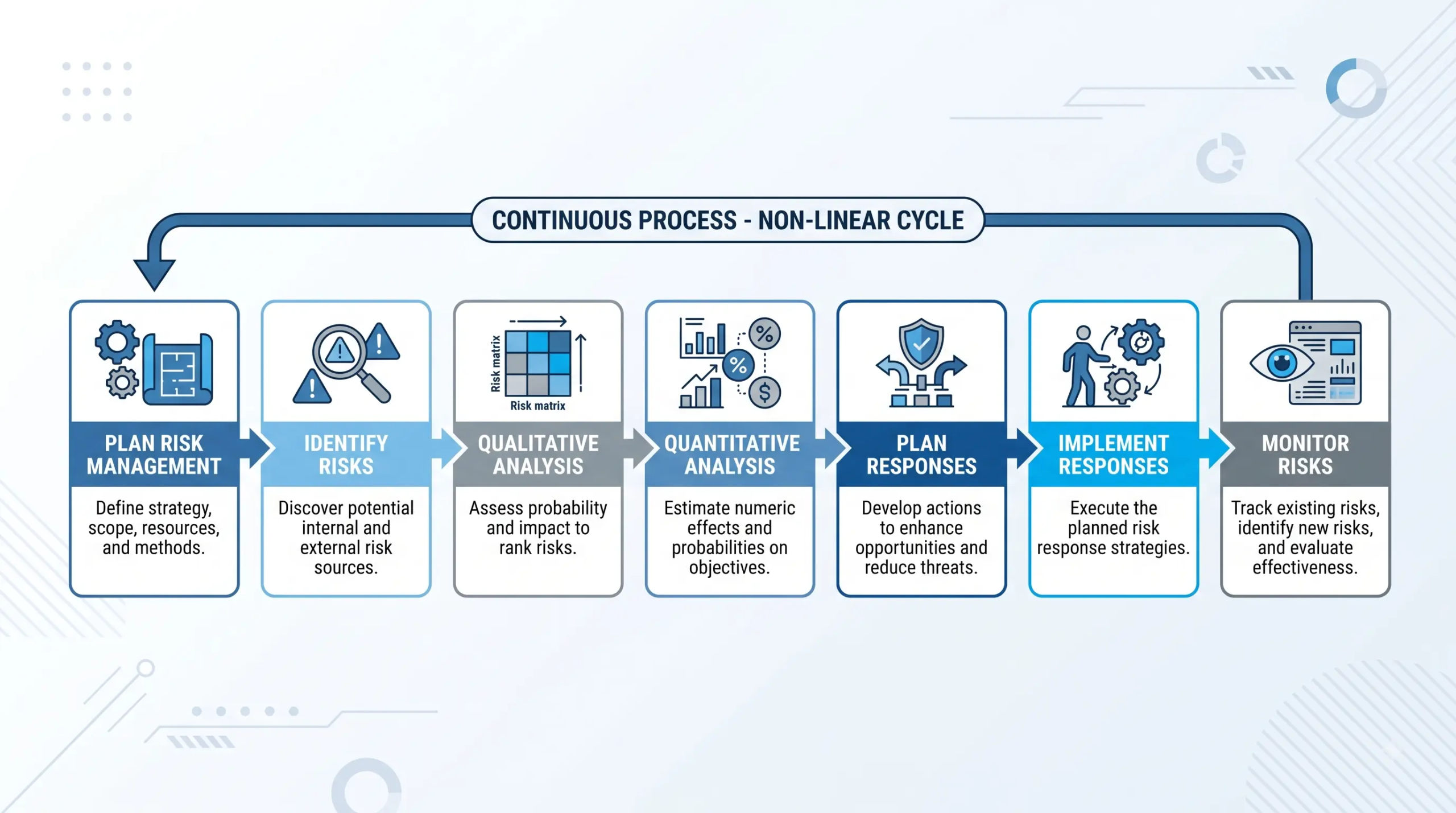
PMBOK organizes risk management as a continuous cycle, not a one-time activity performed at project kickoff:
- 1. Plan Risk Management. Define how risk activities will be conducted — roles, methodology, and risk categories for this specific project.
- 2. Identify Risks. Surface individual risks and overall project risk using techniques like brainstorming, checklists, SWOT analysis, and assumption/constraint analysis.
- 3. Perform Qualitative Risk Analysis. Prioritize risks based on probability and impact — fast, subjective, done on every risk.
- 4. Perform Quantitative Risk Analysis. Numerically analyze the combined effect of risks on project objectives — used selectively on complex or high-stakes projects, often involving Expected Monetary Value (EMV) and Monte Carlo simulation.
- 5. Plan Risk Responses. Develop strategies and actions for the risks identified — this is where response strategies (below) come in.
- 6. Implement Risk Responses. Execute the agreed-upon responses. Assign risk owners who are accountable for making sure the response actually gets carried out.
- 7. Monitor Risks. Track identified risks, watch for new and re-emerging ones, and evaluate whether responses are working throughout the project lifecycle.
The Risk Register: What It Actually Contains
The risk register is the single most important artifact in project risk management — and a frequent subject of PMP scenario questions. A well-built risk register typically tracks:
- Risk ID and description (written as cause → risk → effect for clarity)
- Risk category, often mapped to a Risk Breakdown Structure (RBS)
- Probability and impact ratings (qualitative), and risk score
- Risk owner — the person accountable for monitoring and responding to that specific risk
- Response strategy and specific response actions
- Residual risk (what remains after the response) and secondary risks (new risks the response itself introduces)
- Status — watchlist, active, closed, or triggered
Exam tip: PMI frequently tests whether you know a risk register is a living document, updated continuously through Monitor Risks — not something filled out once during planning and forgotten.
Risk Breakdown Structure (RBS)
The RBS is a hierarchical way of organizing potential risk sources by category — similar in structure to a Work Breakdown Structure, but for risk instead of deliverables. Typical top-level categories include Technical, External, Organizational, and Project Management risks, each broken into more specific sub-categories. It’s most useful during Identify Risks, since it gives the team a structured checklist of where to look rather than relying purely on open brainstorming.
Qualitative vs. Quantitative Risk Analysis
This distinction is one of the most commonly confused topics on the exam. The core difference: qualitative analysis is fast and subjective; quantitative analysis is numeric and selective.
| Aspect | Qualitative Analysis |
Quantitative Analysis
|
| Performed on | Every identified risk |
Selected high-priority or complex risks
|
| Nature | Subjective (probability × impact ratings) |
Numeric, data-driven
|
| Common tools | Probability-impact matrix, risk categorization |
EMV analysis, Monte Carlo simulation, decision trees
|
| Output | Prioritized risk list, risk score |
Numeric measure of overall project risk exposure
|
| Frequency | Done on virtually every project |
Used selectively — larger, complex, or high-cost projects
|
Exam tip: if a question describes numbers, probabilities, or dollar values, it’s pointing to quantitative analysis. If it describes a probability-impact matrix or general prioritization with no numbers, it’s qualitative.
Risk Response Strategies
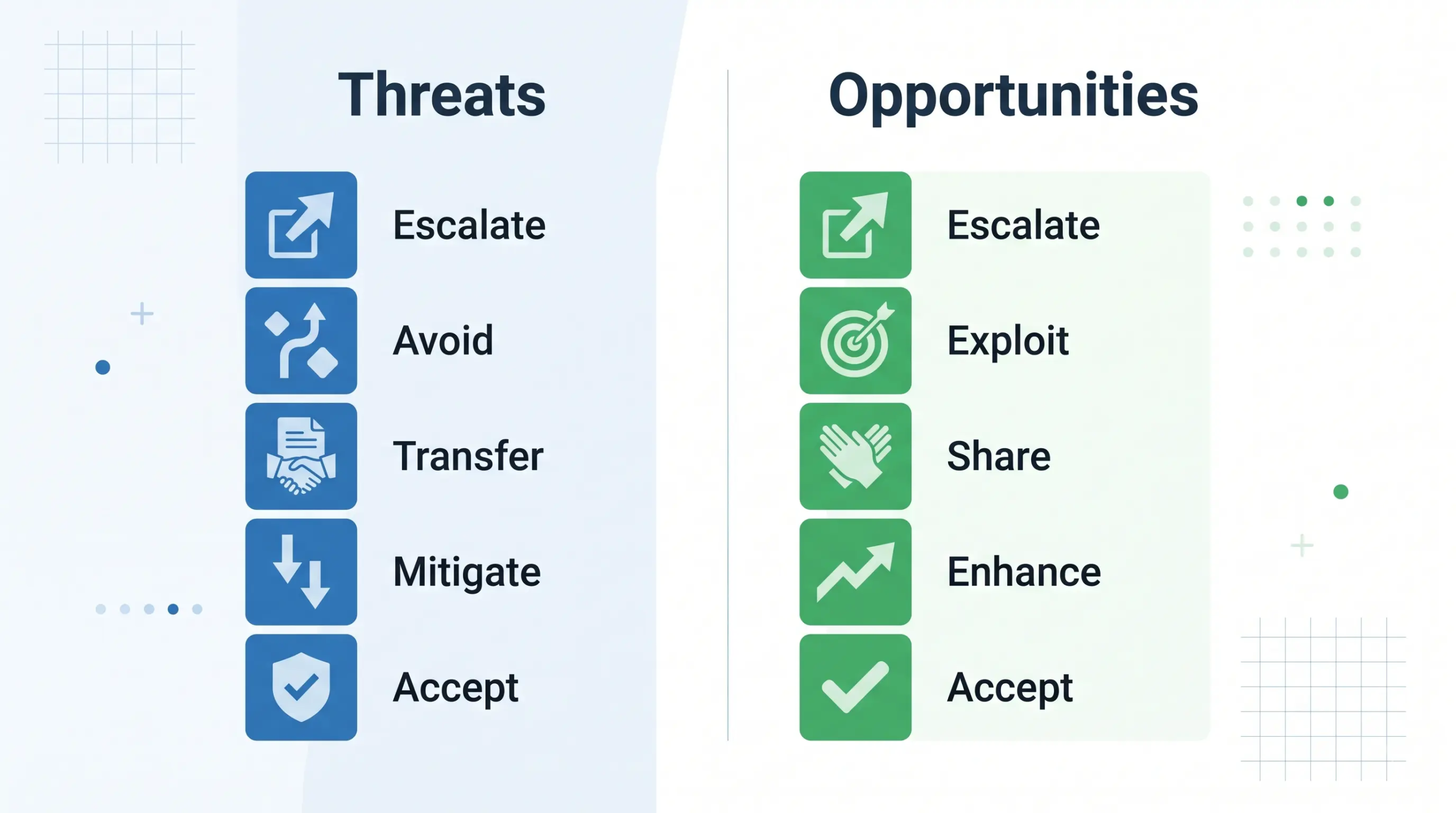
PMI expects you to know two separate sets of response strategies — one for threats (negative risks) and one for opportunities (positive risks). Both sets now include Escalate as a distinct strategy, used when the risk is beyond the project team’s authority or outside the project’s scope entirely.
Responding to Threats (Negative Risks)
- Escalate: Hand the risk to someone outside the project team when it’s beyond your authority or scope — for example, a regulatory risk that needs organizational-level attention.
- Avoid: Change the plan to eliminate the threat or protect the project from its impact entirely.
- Transfer: Shift the financial consequence — and often the ownership — of the risk to a third party, through insurance, warranties, or contract clauses.
- Mitigate: Reduce the probability and/or impact of the risk to an acceptable threshold, without eliminating it entirely.
- Accept: Acknowledge the risk without taking action, either because the cost of response exceeds the risk’s impact, or as a fallback (with a contingency reserve) if other strategies aren’t viable.
Mnemonic: EAT MA — Escalate, Avoid, Transfer, Mitigate, Accept.
Responding to Opportunities (Positive Risks)
- Escalate: Pass the opportunity up when it could benefit the broader organization or program, beyond what the project itself can capture.
- Exploit: Take deliberate action to ensure the opportunity definitely happens — the positive-risk equivalent of Avoid, and the only strategy that aims to fully eliminate the associated uncertainty.
- Share: Partner with a third party better positioned to capture the opportunity on the project’s behalf — the positive-risk equivalent of Transfer.
- Enhance: Increase the probability and/or positive impact of the opportunity — the positive-risk equivalent of Mitigate.
- Accept: Take advantage of the opportunity if it happens, without actively pursuing it.
Mnemonic: EESEA — Escalate, Exploit, Share, Enhance, Accept.
Two secondary concepts often show up alongside response strategies: residual risk is what remains after a response is applied — no strategy except Exploit aims to remove all uncertainty. Secondary risk is a brand-new risk created by implementing a response — for example, exploiting an opportunity to adopt new technology might introduce a new technical risk of its own.
Risk Appetite, Tolerance, and Threshold
- Risk appetite: The general, high-level amount of risk an organization is willing to accept in pursuit of value — a broad attitude, not a number.
- Risk tolerance: The specific range of acceptable variation around an objective — for example, a willingness to accept a 10% schedule variance.
- Risk threshold: The exact point at which risk becomes unacceptable and requires action or escalation — the line that, once crossed, triggers a response.
Think of it as a hierarchy: appetite is the philosophy, tolerance is the range, threshold is the trigger point.
Common PMP Exam Traps on Risk Management
- “Which strategy should be used?” scenarios: Read for keywords. No third party mentioned → cross out Transfer. Risk can’t physically be avoided (like weather) → cross out Avoid. Authorization needed beyond the team → it’s Escalate, not Accept.
- Risk register vs. issue log confusion: A risk is an uncertain future event; once it occurs, it becomes an issue and moves to the issue log, not the risk register.
- Assuming risk planning happens once: PMI tests whether you understand Monitor Risks is continuous — new risks can and do emerge throughout the project, not just at the start.
- Treating Accept as “doing nothing” in every case: Active acceptance includes setting aside a contingency reserve; passive acceptance truly does involve no proactive action. Questions sometimes hinge on this distinction.
Build Your Risk Management Foundation with ShriLearning
Risk management is one of the most heavily tested topics on the PMP exam, and scenario questions reward pattern recognition built through practice. Test yourself with our free 75-question PMP mock exam, build a study schedule with the ShriLearning Study Plan Generator, or explore risk management alongside the People domain in our Stakeholder Management Plan for PMP guide. For structured, live prep across all 2026 ECO domains, check our upcoming PMP Online Training batches.
FAQs
More for you
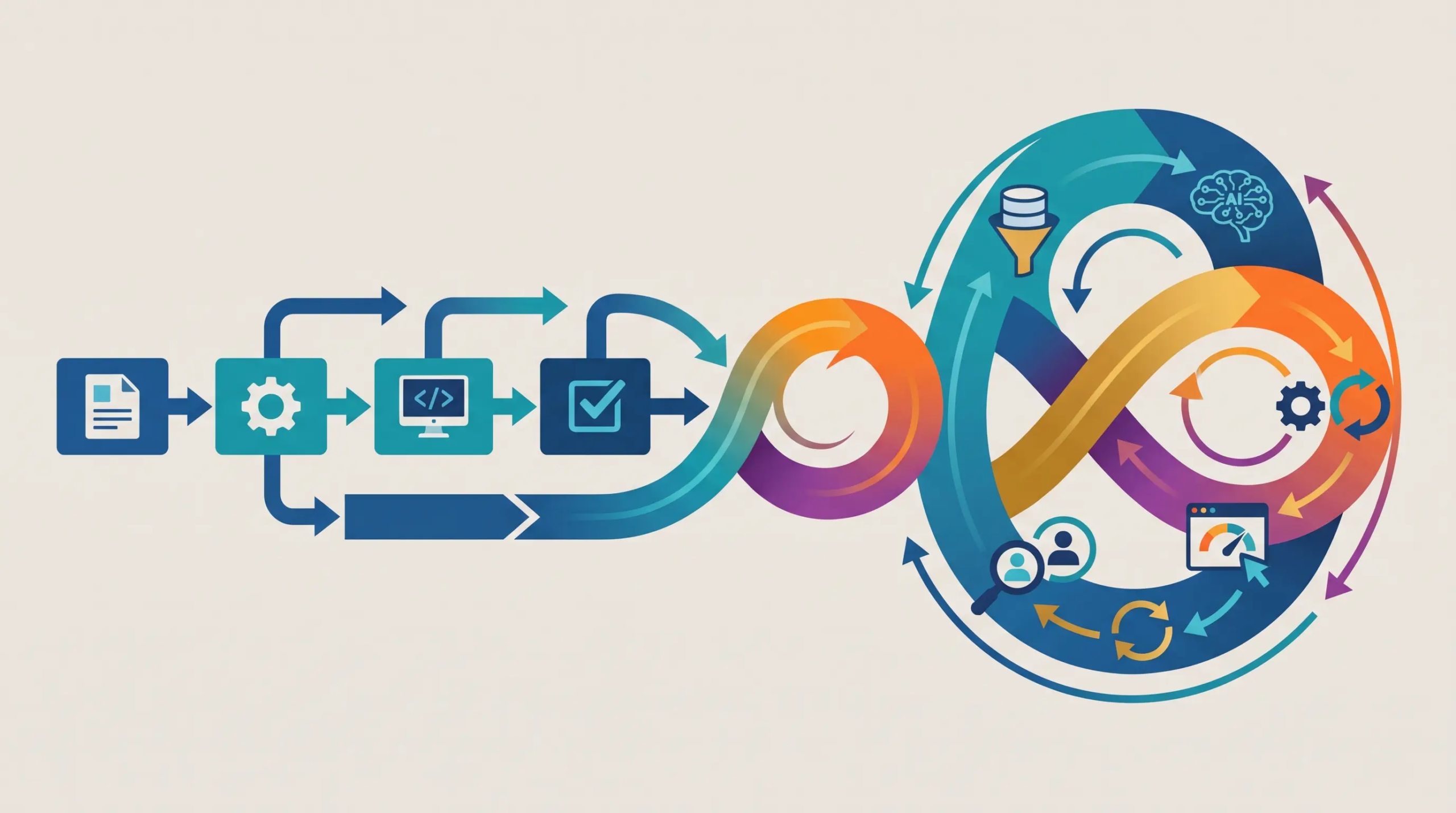

6 Phases to Run a Successful AI Project
saketpratapsinghdm2026-10-25T15:57:35+05:30October 25th, 2026|

How to Transition From Project Manager to PMO Leader
saketpratapsinghdm2026-10-25T14:09:58+05:30October 25th, 2026|

Sustainable AI Starts with Trustworthy AI: A 2026 Guide for Project Managers
saketpratapsinghdm2026-10-24T17:34:12+05:30October 24th, 2026|

Leading Teams Through Change: How Project Managers Can Drive Successful Transformation in 2026
saketpratapsinghdm2026-10-24T16:59:20+05:30October 24th, 2026|

How to Use AI in Project Management: 10 Practical Workflows
saketpratapsinghdm2026-10-24T15:55:17+05:30October 24th, 2026|
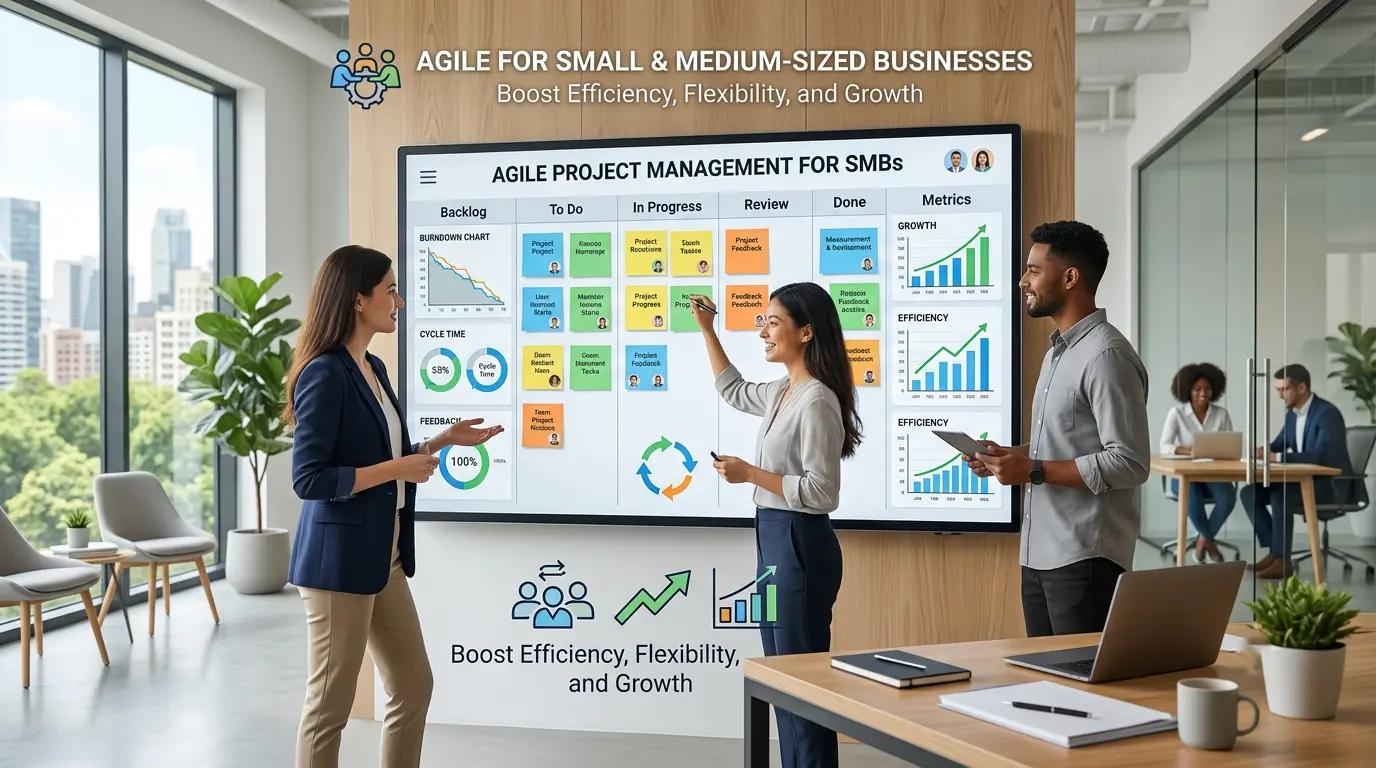
Benefits of Agile Project Management for Small and Medium-Sized Businesses
saketpratapsinghdm2026-09-28T10:12:30+05:30September 28th, 2026|

Work Breakdown Structure (WBS): The Complete PMP Guide, With a Worked Example
saketpratapsinghdm2026-09-21T16:48:15+05:30September 21st, 2026|
Stakeholder Management and RACI: The Complete PMP Guide (With a Worked Example)
saketpratapsinghdm2026-09-21T15:07:42+05:30September 21st, 2026|