
Most AI budgets get approved on the strength of the technology. The delivery model, meaning who owns the outcome, when the money stops and what happens after the pilot, barely gets a paragraph.
That gap is where the money goes missing. Analyst forecasts and project research now point to the same cause of AI program failure: weak delivery governance. And delivery governance is a project manager’s home ground.
This guide explains what the research says, how to translate it into project controls, and a six-check routine any project manager can run before an AI initiative gets funded.
What the research says
Three published sources frame the problem. All three are worth reading in full.
| Source | Date | What it found |
|---|---|---|
| Gartner press release | June 2025 | Over 40% of agentic AI projects are predicted to be canceled by the end of 2027, driven by escalating costs, unclear business value or inadequate risk controls. |
| Gartner press release | April 2026 | Guidance on six steps to manage AI agent sprawl, the uncontrolled spread of agents across an enterprise. |
| Gartner press release | May 2026 | 40% of enterprises are predicted to demote or decommission autonomous AI agents by 2027 because governance gaps were found only after production incidents. Treating governance as all-or-nothing is named as the root cause. |
| PMI Pulse of the Profession 2026 | 2026 | About 31% of complex projects fail to deliver the full scope of intended benefits, against 12% in PMI’s 2024 research. Value and alignment gaps are the most common fallout. |
The phrase to notice in the Gartner finding is “only after production incidents.” The gaps were there all along. Nobody was accountable for finding them.
Why this lands on the project manager
Read the failure triggers one by one and each one maps to a discipline project managers already practice.
| Failure trigger | Project discipline that owns it |
|---|---|
| Escalating costs | Cost control and forecasting |
| Unclear business value | Benefits definition and sponsor alignment |
| Inadequate risk controls | Risk management and scenario planning |
| Gaps found after production incidents | Stage gates and governance reviews |
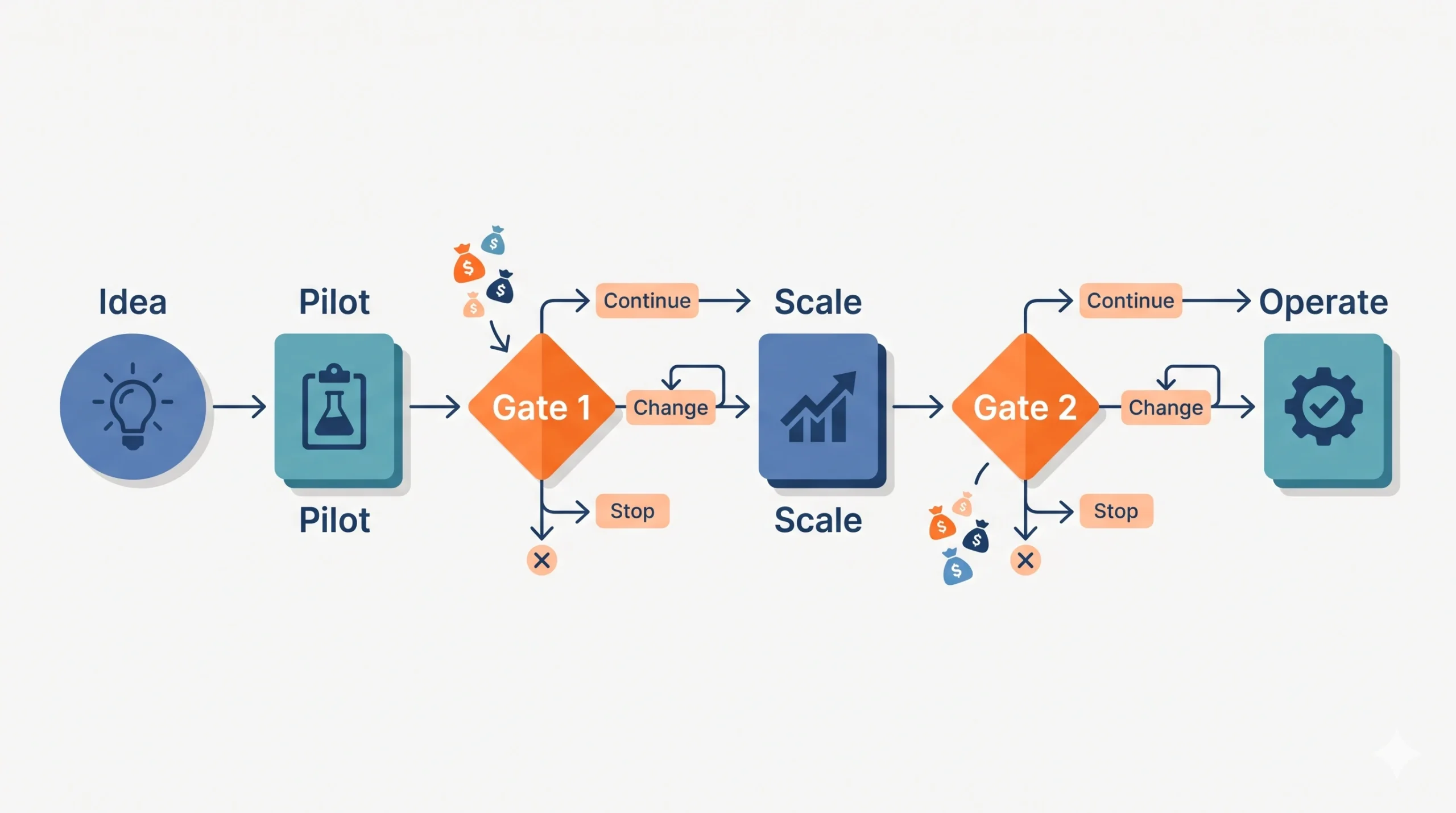
A stage gate is a scheduled checkpoint where a program has to earn its next round of funding. Most AI pilots skip it. They launch as experiments, quietly grow into dependencies and never face a formal “continue, change or stop” decision.
PMI’s research adds a useful detail. Senior leaders and project teams often diagnose the same situation differently. Leaders point to technology cycles and regulation. Project teams feel it as shifting scope and conflicting priorities. When the two views never get reconciled, the response splits too. A named sponsor and a written outcome are what close that gap.
The levers that separated high performers in the same research were ordinary ones:
- Sponsor alignment at initiation: about four in ten high performers used it, against about three in ten low performers.
- A structured framework: teams rated 72% of projects successful with one, against 61% without.
- Scenario planning: helpful for catching emerging threats early, yet used by only about one in five practitioners.
- A functioning PMO: organizations with one were more likely to use every practice above.
None of this is new. What is new is applying it to AI work, where the temptation is to treat the technology as the project and skip the controls.
The binary governance trap
Gartner’s May 2026 finding describes the failure pattern clearly. Many organizations treat an AI agent as either locked down or fully trusted. There is no middle.
Both ends fail:
- Locked down: the agent can do so little that it never produces value, and the program gets canceled for unclear returns.
- Fully trusted: the agent acts without limits, and the first serious incident forces a shutdown.
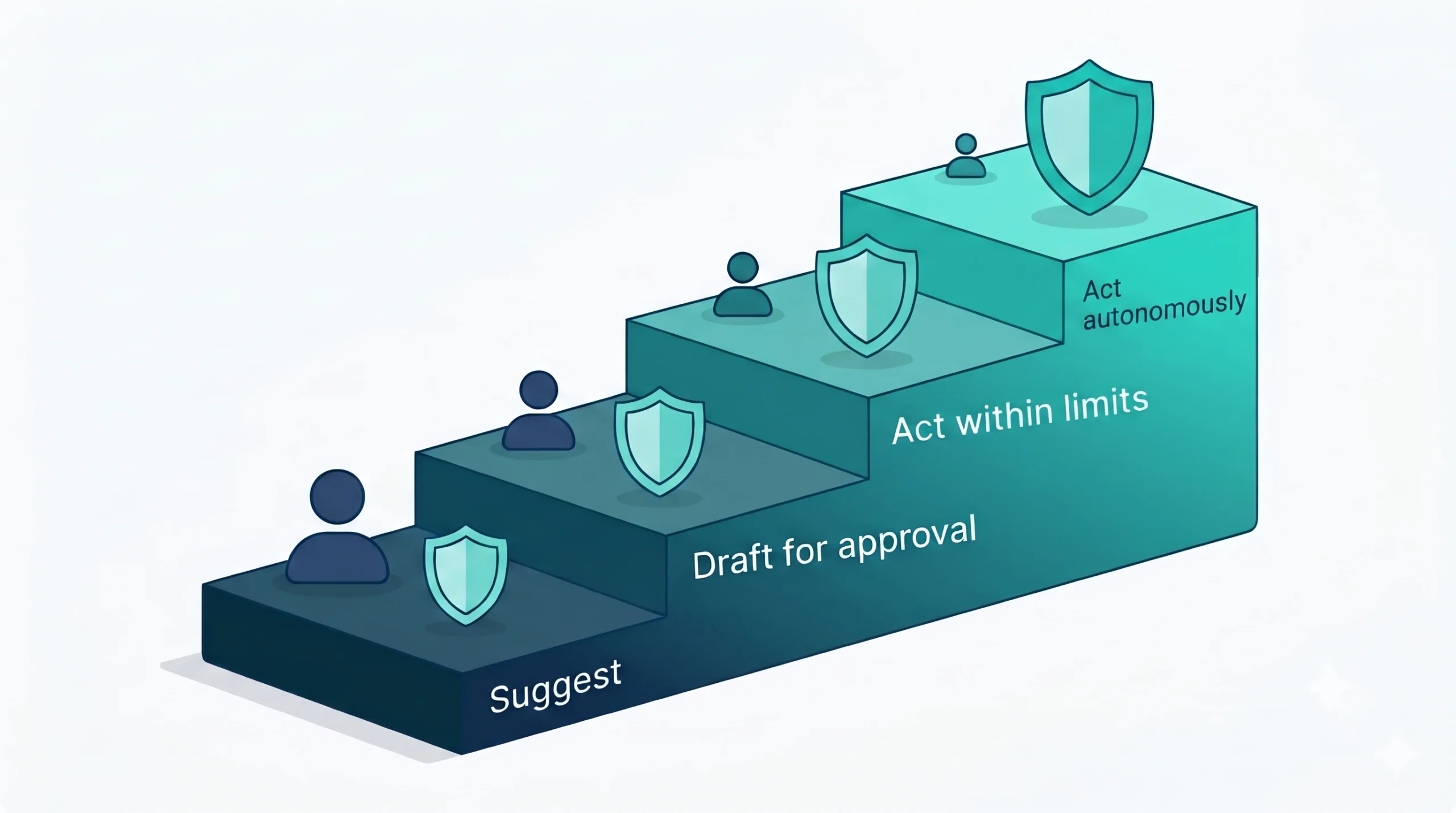
Gartner’s recommended alternative is proportional governance. Agents are classified by how much autonomy they have, and each level gets its own trust boundary and controls. Academic work on agent autonomy has proposed similar tiered models, for example a five-level framework from the University of Washington.
For a project manager, this turns a vague worry into a plannable item: decide the autonomy level, the controls for that level and the review schedule while the budget is still being set.
An example autonomy model (illustrative)
The ladder below is an example for teaching purposes. It is not a Gartner or PMI standard. Adapt the names and limits to the organization.
| Tier | What the agent does | Human role | Typical controls |
|---|---|---|---|
| 1. Suggest | Offers options or summaries. Takes no action. | Decides and acts | Output review, usage logging |
| 2. Draft for approval | Prepares an action and waits | Approves every action | Approval trail, sampling of rejected drafts |
| 3. Act within limits | Acts alone inside set boundaries (spend, scope, data) | Reviews exceptions and samples | Hard limits, alerts, rollback plan |
| 4. Act autonomously | Acts and decides with minimal oversight | Audits after the fact | Full audit log, independent review, kill switch |
Most project work belongs in tiers 1 to 3. Tier 4 needs a strong justification, a named accountable owner and a tested way to switch the agent off.
Worked example: two agents, two tiers (illustrative)
This scenario is invented to show the method. The numbers and names are placeholders.
Agent A: weekly status summarizer. It reads task updates and drafts a status note. A project manager reviews the note before it goes to the sponsor.
- Tier: 1 (Suggest).
- Why: a wrong summary is embarrassing but easy to catch and correct.
- Controls: spot-check against the source tasks each week.
Agent B: resource reallocation agent. It moves team members between tasks to balance workload.
- Tier: 3 (Act within limits) at most, and only after a pilot at tier 2.
- Why: a wrong move affects people, deadlines and cost, and may not be noticed immediately.
- Controls: cap on moves per week, no changes to people on critical-path tasks without approval, weekly exception report, one-click rollback.
Same technology, very different governance. Treating both the same way, either by locking both down or trusting both fully, is exactly the binary mistake.
Six checks before funding any AI initiative
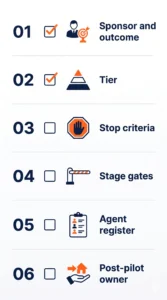
Run these before build starts. Each takes minutes if the answer exists and flags a real problem if it does not.
- Name the accountable sponsor and the written outcome. Who owns the result, and what specific business outcome has been agreed in writing? If neither can be stated, the work is an experiment, even if the budget line calls it a program.
- Classify every agent by autonomy tier. Use a ladder like the one above. Record the tier and the reason in the project charter or plan.
- Define stop criteria and a demotion path. What has to be true for the project to stop? What sits between “running” and “shut down”? An agent that misbehaves should be able to move down a tier, not just off.
- Tie funding to stage gates. Release money in tranches. Each gate asks the same questions: is the outcome being achieved, are costs on forecast, have risks changed and is the agent still at the right tier?
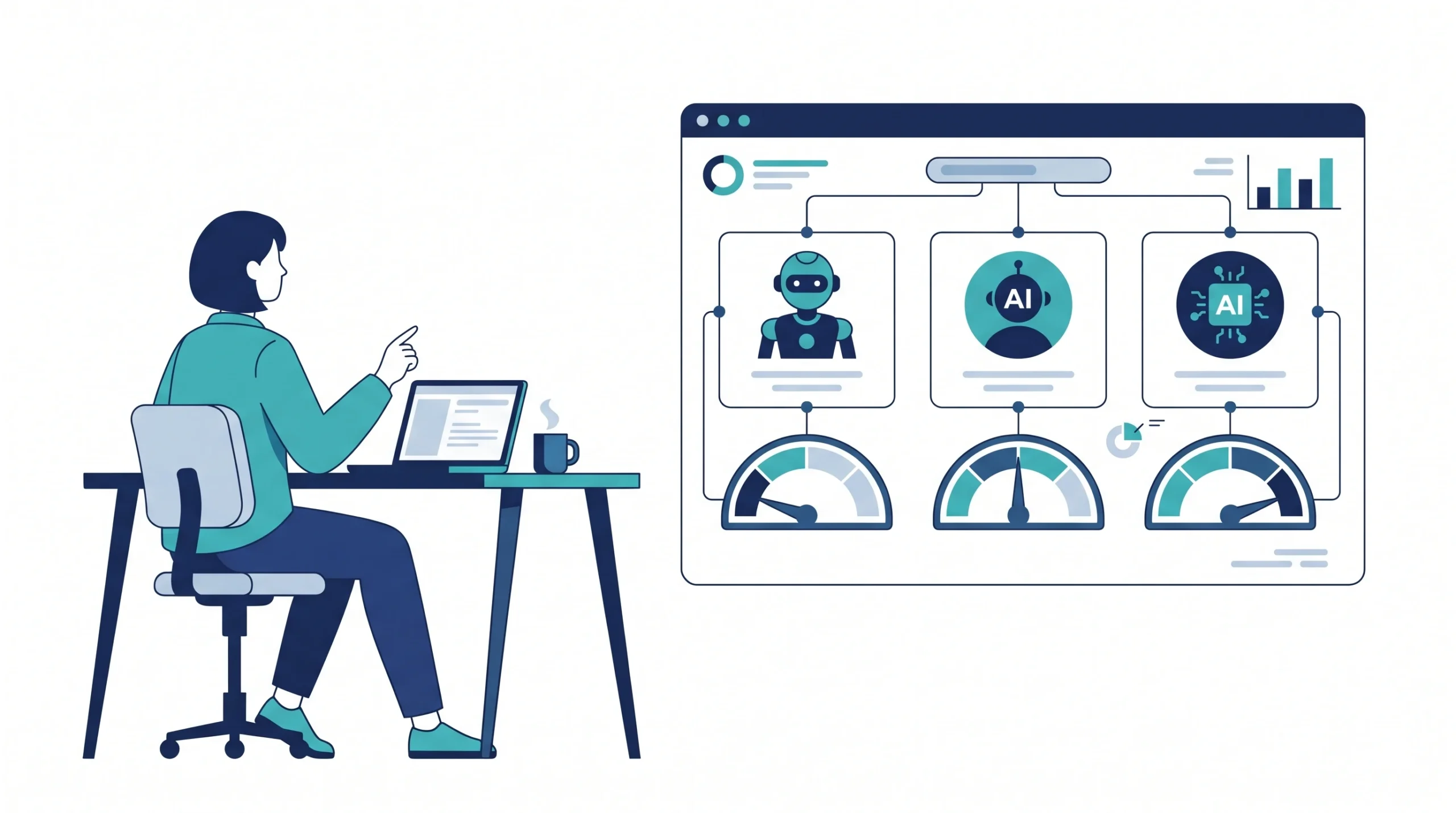
- Keep an agent register. List every agent, its owner, its tier, the data it touches and the date of its last review. This is the practical answer to agent sprawl, because a team cannot govern what it cannot list.
- Decide where the capability lives after the pilot. Who runs it, funds it and answers for it once the project closes? Pilots that have no post-project owner tend to drift or die.
Stop criteria template
Fill the placeholders with values agreed with the sponsor. The thresholds below are examples to show the format, not recommendations.
| Trigger | Threshold (set per project) | Action | Decision owner |
|---|---|---|---|
| Cost forecast overrun | [x]% above approved budget | Pause and review at next gate | Sponsor |
| Benefit shortfall | Outcome metric below [x] for [n] reviews | Reduce scope or stop | Sponsor |
| Serious error or incident | Any incident of defined severity | Demote one tier, investigate | Project manager |
| Data or compliance breach | Any confirmed case | Suspend agent, escalate | Risk owner |
| No named post-pilot owner | At gate review | Hold funding | Sponsor |
What this means for PMP candidates
PMP candidates sometimes ask whether AI governance is a tested topic. The honest answer, based on the current Exam Content Outline effective July 9, 2026, is that AI is mentioned in the introduction as an industry trend. It is not a task or an enabler in the outline.
What is tested is the underlying skill set. Governance sits in the Business Environment domain, which carries 26% of the exam, alongside compliance, change and benefits. Risk, issue and change control, stakeholder alignment and stage-gate thinking all appear in scenario questions regardless of the technology involved.
So the practical takeaway is to study governance and benefits management well. The AI angle is a strong real-world example of the same principles, not an extra syllabus item.
Common mistakes
Funding the technology instead of the outcome. A demo that impresses is not a business result. Tie money to the measured outcome.
Treating all agents the same. One blanket policy will be too loose for risky agents and too tight for harmless ones. Classify first.
No off-ramp between “on” and “off.” Without a demotion option, teams hesitate to act on early warning signs because the only choice is a full shutdown.
Skipping the agent register. Sprawl starts with one team quietly adding one more tool. A simple list prevents it.
Letting the pilot become production by default. If no gate decision was ever made, the pilot was never really approved. Force the decision.
Reviewing only after something breaks. Schedule reviews up front. Waiting for an incident is the pattern the research warns about.
Next steps
Governance is easier to practice when the fundamentals are solid. If PMP preparation is on the list, a good starting point is to check where the gaps are.
- Take the free PMP mock test to see how Business Environment questions feel: Free PMP Mock
- Build a study schedule around the exam date with the Study Plan Generator
- For structured, live preparation, see the ShriLearning PMP Online Training page.
Related reading on ShriLearning:
FAQs
It is the set of decisions and controls that keep an AI initiative accountable: a named sponsor, a written outcome, agent autonomy levels, stop criteria, stage gates and a post-pilot owner. It applies familiar project disciplines to AI work.
Gartner points to escalating costs, unclear business value and inadequate risk controls. PMI's research adds value and alignment gaps, where projects deliver outputs but miss the intended outcome.
They describe how much an agent can do without a human step, from suggesting options to acting independently. Each level gets matching controls. The four-tier model in this guide is an illustrative example, not a standard.
Treating an agent as either locked down or fully trusted. Gartner names this as the root cause of agent failure and recommends proportional governance by autonomy level instead.
AI appears in the 2026 Exam Content Outline introduction as a trend, not as a task. Governance, risk and benefits are tested under the Business Environment domain, which is 26% of the exam.
Cost overrun limits, benefit shortfall thresholds, incident severity triggers, compliance breaches and a missing post-pilot owner. Each needs a named decision owner and a defined action.
Agent sprawl is the unmanaged spread of AI agents across teams. A central agent register listing owner, tier, data access and review date is the simplest first control.
More for you
AI Governance in Project Management: Autonomy Levels, Stop Criteria and Stage Gates (2027)
saketpratapsinghdm2026-11-24T00:15:04+05:30November 24th, 2026|

PMO Maturity and Alignment (2027): Why You Need Both to Deliver Real Value
saketpratapsinghdm2026-11-20T14:23:47+05:30November 20th, 2026|

Risk Breakdown Structure (RBS) for AI Projects (2027): How to Map and Control AI Risk
saketpratapsinghdm2026-11-20T13:59:34+05:30November 20th, 2026|

Project Charter Guide (2026): How to Authorize Work, Align Strategy & Use AI
saketpratapsinghdm2026-11-18T00:37:14+05:30November 18th, 2026|

PMI Global Summit 2026 Highlights: 5 Major Announcements & Career Takeaways for 2027
saketpratapsinghdm2026-11-18T00:07:49+05:30November 18th, 2026|
What happens when you ask AI models to search, compare and give a list of top PMP Training providers
rahul.gupta@shrilearning.com2026-11-10T15:11:18+05:30November 10th, 2026|

Using Artificial Intelligence for Scrum Masters in the Year 2026: Applying AI Throughout Scrum Events While Maintaining the Team’s Confidence
saketpratapsinghdm2026-10-30T22:14:53+05:30October 30th, 2026|

6 Phases to Run a Successful AI Project
saketpratapsinghdm2026-10-25T15:57:35+05:30October 25th, 2026|